Showing posts with label Mario Bava. Show all posts

Wednesday, August 4, 2010

Hatchet for the Honeymoon (1970)

We open on a train, as a man with a meat cleaver stalks a young couple. This opening scene is shot from the point-of-view of the killer, a technique later popularized by Halloween, but despite the subject matter and pulp title the movie quickly develops a poetic, melancholic mood. The first hint of this comes with the evocative shots of a young boy, who we soon realise is the killer's younger self watching him from inside his head. The cinematography uses psychedelic techniques, but rather than this being just a sign of its being made in 1970, it is used to depict the inner life of the killer.

The movie cuts quickly from the opening murder to a close-up of a toy train rattling along a track. Just as we are prepared to mock the movie for such obvious fakery, a hand reaches down and stops the train. The hand belongs to the killer from the opening sequence, and he commences with a voice-over.

"My name is John Harrington. I am a paranoiac. Hmm, paranoiac. An enchanting word, so full of possibilities. The fact is that I am completely mad. The fact remains that I have killed five young women."

Young, vain and impotent - no wonder Stephen Forsyth retired from acting after this role

This is the world of Mario Bava, the co-writer/cinematographer/camera operator/director whose movies embodied all the best elements of the Italian horror movie. Bava's movies, despite their pulp titles and plots and their commercial bent, were almost all intensely personal and distinctive. Hatchet for the Honeymoon is a good example of Bava's art, weaving a sophisticated and multi-layered story out of what would usually be handled as trash. The story is not the point here - it's all in how he handles it. This is pulp poetry of the highest order, and it would be much imitated in the subsequent decade, particularly in the movies of Dario Argento.

John Harrington is portrayed as a vain and shallow young man. At first he seems to be trapped in an unhappy marriage, with a shrewish older wife who refuses to give him a divorce. This rang alarm bells with me, with its misogynistic overtones, but Bava and his cast undermine these elements beautifully. We are given glimpses throughout that Mildred Harrington has been driven to this state by John's manipulative nature and inability to satisfy her.

John is driven by two of the great clichés of movie psychos: issues with his mother, and impotence. What makes this interesting is that, although this is obvious to the audience almost from the start, John himself is unaware of it and is in fact attempting to discover the roots of his own madness. Each time he kills John's memory opens up a little more, and he feels driven to keep killing until he has finally remembered what started him in the first place.

Hatchet for the Honeymoon is in essence a character study. Only one brief scene takes us away from John, so that just once we are left to wonder whether he has committed a murder or not. He is depicted from the beginning as vain and shallow, spending endless time on his appearance. He runs a fashion business specialising in bridal wear left to him by his mother, but Mildred's money bailed it out and it's only her that keeps it afloat (one of several instances where his wife is shown to be a mother substitute). All but one of his victims are all brides-to-be, so that he is always symbolically killing both his wife and his mother.

Then two things happen with unforeseen consequences. John meets a young woman called Helen Wood, and discovers he has actual feelings for her; and he finally kills his wife.

The scene where John kills Mildred is also the one where she is transformed into a sympathetic character. What leads him to kill her is not her mean-spirited comments, as she had displayed earlier in the movie, but her softening towards him. We discover that she really loves John and wants nothing more than for him to love her in return. The coldness in their relationship comes completely from him - they have never actually consummated their marriage because he is impotent. So John dresses as a bride himself, hacks her to death with a meat cleaver, and buries her in the hothouse.

However Mildred is not going to give up on him that easily. Wherever John goes from then on, people keep greeting his wife, asking her opinion, serving her drinks, and even having long conversations with her. They can see her. The camera can see her. But John cannot see her.

The true hero of this movie

This is approach to a ghost story that I don't think I have ever seen before, and it's impressively handled. The movie puts us completely on Mildred's side, while allowing us to feel John's palpable fear at her presence - especially in the few instances when she allows him to see her, and one where she touches him. Bava's tricky camerawork allows her to appear and disappear without cutting, and Laura Betti's excellent performance as Mildred makes these scenes extremely memorable.

After she appears to him and tells him that she will never leave his side, John attempts to exorcise Mildred by digging up her body and cremating her in the furnace. He carries her ashes around with him in a satchel, as a sick joke, but instead of the satchel people continue to see Mildred. It doesn't matter if he throws away the satchel and scatters the ashes - it keeps returning to him.

Meanwhile Helen is pushing John for a sexual relationship, and as for him sex means murder he is unwilling to commit to someone he actually cares for. At the same time a police inspector keeps dropping around to talk to him, obviously thinking that John is the prime suspect (several of the victims were models working for him) and trying to work on his mind in the absence of any physical evidence. The scene where the inspector almost catches John killing Mildred milks it for suspense in a manner that rivals the best of Hitchcock.

The final revelation is not a surprise to the audience, and the final scene - where Mildred gets the last laugh - is also predictable but still extremely satisfying.

This is an excellent thriller, provided you don't mind the end being so predictable. Bava's visual tricks are all tied into exploring character - the uses of many mirrors and reflecting surfaces, for example, or his characteristic use of the zoom to highlight irony. It would not be a bad introduction to Italian horror in general.
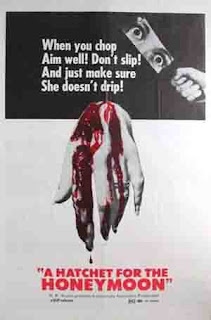
Poster

Friday, May 21, 2010

The Whip and the Body (1963)

Here's an example of two kinds of ghost story that I like a lot: the returning lover, and the "ambiguous ghost". It's also an Italian movie, and I'm all about Italian horror movies. It's co-written and directed by Mario Bava, probably the greatest of all Italian horror movie directors, and it features top horror star Christopher Lee. To top it all off, it was a very controversial movie in its day and was cut to shreds in most countries when it was first released, to the point where it was apparently incomprehensible.

If released now, it would probably be rated PG.

The Whip and The Body is Gothic horror in all senses. It's a period movie (though as with many of these things, the period it is set in is ambiguous) and it features a crumbling old castle, secret passages, doomed love, unsympathetic characters, delirium, suicide, murder, and unmotivated coloured lighting.

The story involves the return of Kurt (Christopher Lee) to the family home and the disruption this causes. Kurt's former lover Nevenka (played by stunning Israeli actress Daliah Lavi) is now married to his brother, who is in love with another woman, Katia. The housekeeper, Giorgia (Bava regular Harriet White Medin), is still grieving the loss of her daughter, who had committed suicide after being seduced then abandoned by Kurt. Of course, Kurt's return awakens old passions in Nevenka, and the thoroughly hissable Kurt revels in the chaos he is causing.

So far, so whatever. But what made this movie so controversial (and still makes is quite unusual) is that Kurt and Nevenka's relationship is openly sadomasochistic. A good four years before Luis Buñuel's brilliant Belle de Jour, The Whip and the Body features a woman with vivid masochistic fantasies as its protagonist and puts the viewer within her viewpoint.

As a movie of its time, it is not terribly sympathetic to its sadomasochistic couple even as it mines them for prurient interest. Kurt is portrayed as a vile and utterly self-absorbed villain, and Nevenka is shown to be mentally ill. Tony Kendall as Nevenka's husband and Ida Galli as his unrequited love interest are probably supposed to be the audience identification figures, but Dahlia Lavi and Christopher Lee dominate the movie, with performances far more memorable than any of the supporting cast, so that despite their obvious defects we are far more interested in them.

But then again Heathcliffe and Cathy were not terribly sympathetic either, and people just love Wuthering Heights (which was definitely an influence on this movie), so audience sympathy is obviously a tricky thing.

Before long, Kurt is murdered and the movie becomes a combination of whodunnit (far too easily guessed) and romantic ghost story, as the shade of Kurt seems to visit Nevenka in the night, filling her with a combination of terror and desire. Is that the sound of his horse-whip, or is it just the trees lashing against the castle walls?

Incidentally, Lee apparently has a clause written into his contracts that he will not be required to perform scenes of a sexual nature or even to kiss on the lips. (Which hasn't stopped directors like Jess Franco from some creative editing to put him into outrageous scenes.) Either this clause was not present in his Whip and the Body contract or he chose to ignore it, as his scenes with Lavi are about as steamy as you could get at the time.

As usual, Bava's mastery of the camera turns the movie into a visual feast. As well as co-writing (with Ernesto Gastaldi, master of kinky Italian horror) and directing he is the uncredited cinematographer and the camera operator, and he also executed the matte paintings and other special effects.

This almost makes up for the slightly cheesy score by Carlo Rustichelli, which sounds like something out of a soap opera. Others (such as Bava's biographer Tim Lucas) praise Rustichelli to the skies, but compared to other Italian genre composers like Ennio Morricone, Bruno Nicolai and Riz Ortolani, he doesn't sound interesting to me.

There are several notable plot holes in the movie, and I didn't find the ending terrinly satisfying. The biggest problem, however, is that Christopher Lee did not dub his own voice on the English-language track. (Everyone except for Lee voiced their own role on the Italian-langue track.) Lee has a particularly commanding voice, so this is a real pity.

It's also not really the best introduction to Italian horror or to the films of Mario Bava. There are actually two other Bava ghost stories that I like more (the mind-bending, if dreadfully titled, Kill Baby Kill! and the utterly terrfying "Drop of Water" segment of the anthology film Black Sabbath), both of which I intend to get to later in this series, but when Kate visited me recently, she saw the dvd cover of this movie and wondered what the hell I had been watching (and it does indeed look lurid, as demonstated below) so I thought I would do this now.