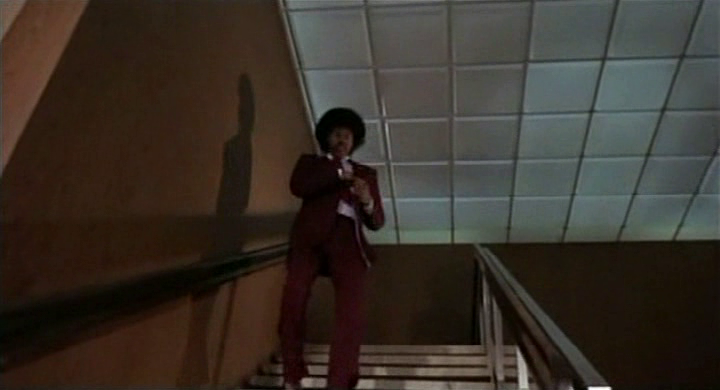
The thugs drag your wife into the kitchen. One of them bends down in front of you and pulls off his balaclava, revealing himself to be Luc Devereaux (Jean-Claude Van Damme). Devereaux then shoots your wife in the head. As you scream and scream, the thugs drag your daughter into the kitchen as well, and Devereaux is just about to shoot her as well when there is a flash of white light and you wake up in a hospital, having been in a coma for nine months; apart from the vivid memory of the slaughter of your family, you have almost complete amnesia.

As well as succinctly setting up the situation and establishing the traumatized condition that the protagonist finds himself in, this scene ultimately serves to tell us that this movie does not play by the rules. Any expectations that we had about seeing a normal genre sequel have been smashed, and deservedly, because in terms of style, theme, content and tone, co-writer/director John Hyams has produced a unique personal vision with Universal Soldier: Day of Reckoning. The fact that he's done it with the sixth entry in an action movie series that was kicked off by Roland Emmerich is even more remarkable.

The previous movies in this series mostly dealt with the idea of "UniSols," soldiers who had been killed in battle. In the entry right before this one, Universal Solder: Regeneration, we were introduced to the next generation of UniSols, who are clones whose damaged body parts can be replaced Frankenstein-style. They're supposed to be the next generation of unstoppable soldiers, but up until now they've shown an alarming predilection for killing each other before they can get near to the enemy. This movie goes straight to the oddly under-utilized heart of the matter - these are cyborg zombies - and puts us right into the darkest part of this idea.

We follow the protagonist John (Scott Adkins) as he is discharged from hospital and attempts to put his life back together. He receives a strange phone call that starts leading him down a trail of forgotten acquaintances and dead bodies towards Devereaux, even as he finds evidence that seems to suggest that he is responsible for some of the corpses he encounters. He is also stalked and attacked on several occasions by a next-generation UniSol dressed as a plumber (Andrei Arlovski), who has been deprogrammed by a cloned Andrew Scott (Dolph Lundgren) and has enlisted in Devereaux's army/religious cult.

Hyams uses an interesting, non-standard stylistic toolbox. For example, this movie features some of the most relentless use of strobe lighting I've seen outside of a Gaspar Noé movie. For the fight scenes he favours long takes, allowing us to see the fighters in motion. The fights themselves are hard-hitting and brutal, and feature every possible combination of fists, blunt objects, sharp objects and firearms. The sound design is very notable as well. The score is minimal both in terms of what is presented - an abstract soundscape with no traditional cues and no driving action-movie rhythms or beats - and in that many scenes pass without any music in them at all. The music we do get is nicely abstract and blends perfectly with the movie, for example the trilling sound during the strobing hallucination scenes. The sound during the action scenes is punched up to emphasise impact; blows are landed with what sounds like crushing force.

Thematically, the movie is deep in Philip K. Dick territory, with a paranoid protagonist who is trying to figure out who exactly he is any why he seems to have done so many terrible things that he has no memory of. Original movie stars Dolph Lundgren and Jean-Claude Van Damme return in vastly altered roles, this time appearing on the same side: Andrew Scott (Lundgren) is now a John the Baptist figure, preaching salvation in the name of Luc Devereaux (Van Damme) as a Messiah who has figured out a way to break the UniSols' programming and set them free. Even in this freedom they remain violent and constantly on edge, requiring little provocation to turn on one another. Devereaux ultimately comes over as a figure reminiscent of Kurtz from Heart of Darkness - some explicit visual references to Apocalypse Now drive this home.

The two star names are both given the chance to do something different to what is usually expected of them. Lundgren is given entire speeches to deliver, which he digs into with obvious relish. Van Damme's role, though larger, is more stoic; in some ways he gives an extension of his melancholy performance from the arthouse hit JCVD. When John finally comes face to face with Devereaux, Van Damme greets him wearily and with resignation, as if something inevitable is coming to pass that he had been holding off for some time. Adkins is perfectly serviceable playing a confused everyman (his acting is a lot better here than in movies like Undisputed 3: Redemption or Ninja) but the fight scenes show us the real reason that he was cast in this movie. In the last third, when he shows us what he can really do, it's clear that hiring a top martial artist and working on his acting was a better idea in this instance than hiring a top actor and teaching him to fight.

On the strength of what he's done here, I would fully expect John Hyams to go on to bigger movies. I for one hope that whatever kind of budget he ends up working with, he's given creative freedom, because the amount of imagination and ambition put into this movie is exactly the sort of thing that films on all levels need.
Now I'm not trying to say that Universal Soldier: Day of Reckoning is a flawless movie, because it clearly isn't. For example there are a few plot holes (e.g. it doesn't make sense that the Universal Plumber keeps trying to kill John even after he's been deprogrammed), and there isn't enough information on what Devereaux is up to; there are tantalizing hints, but I could have done with some resolution there. The movie's attitude to women isn't great either; apart from the murdered wife and child in the opening scene and a motherly nurse seen soon afterwards, all of the other women in the movie are strippers or prostitutes; only one has a significant speaking role and she's a girlfriend character mostly used as a post for tying exposition to.

But at the end of the day, this movie does everything that it's supposed to do and more: it's exciting and scary throughout, it features striking cinematic style and it provides plenty of interesting ideas. More of this, please!