Wednesday, August 4, 2010

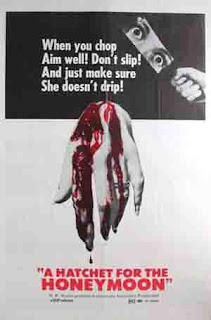
Hatchet for the Honeymoon (1970)

We open on a train, as a man with a meat cleaver stalks a young couple. This opening scene is shot from the point-of-view of the killer, a technique later popularized by Halloween, but despite the subject matter and pulp title the movie quickly develops a poetic, melancholic mood. The first hint of this comes with the evocative shots of a young boy, who we soon realise is the killer's younger self watching him from inside his head. The cinematography uses psychedelic techniques, but rather than this being just a sign of its being made in 1970, it is used to depict the inner life of the killer.

The movie cuts quickly from the opening murder to a close-up of a toy train rattling along a track. Just as we are prepared to mock the movie for such obvious fakery, a hand reaches down and stops the train. The hand belongs to the killer from the opening sequence, and he commences with a voice-over.

"My name is John Harrington. I am a paranoiac. Hmm, paranoiac. An enchanting word, so full of possibilities. The fact is that I am completely mad. The fact remains that I have killed five young women."

Young, vain and impotent - no wonder Stephen Forsyth retired from acting after this role

This is the world of Mario Bava, the co-writer/cinematographer/camera operator/director whose movies embodied all the best elements of the Italian horror movie. Bava's movies, despite their pulp titles and plots and their commercial bent, were almost all intensely personal and distinctive. Hatchet for the Honeymoon is a good example of Bava's art, weaving a sophisticated and multi-layered story out of what would usually be handled as trash. The story is not the point here - it's all in how he handles it. This is pulp poetry of the highest order, and it would be much imitated in the subsequent decade, particularly in the movies of Dario Argento.

John Harrington is portrayed as a vain and shallow young man. At first he seems to be trapped in an unhappy marriage, with a shrewish older wife who refuses to give him a divorce. This rang alarm bells with me, with its misogynistic overtones, but Bava and his cast undermine these elements beautifully. We are given glimpses throughout that Mildred Harrington has been driven to this state by John's manipulative nature and inability to satisfy her.

John is driven by two of the great clichés of movie psychos: issues with his mother, and impotence. What makes this interesting is that, although this is obvious to the audience almost from the start, John himself is unaware of it and is in fact attempting to discover the roots of his own madness. Each time he kills John's memory opens up a little more, and he feels driven to keep killing until he has finally remembered what started him in the first place.

Hatchet for the Honeymoon is in essence a character study. Only one brief scene takes us away from John, so that just once we are left to wonder whether he has committed a murder or not. He is depicted from the beginning as vain and shallow, spending endless time on his appearance. He runs a fashion business specialising in bridal wear left to him by his mother, but Mildred's money bailed it out and it's only her that keeps it afloat (one of several instances where his wife is shown to be a mother substitute). All but one of his victims are all brides-to-be, so that he is always symbolically killing both his wife and his mother.

Then two things happen with unforeseen consequences. John meets a young woman called Helen Wood, and discovers he has actual feelings for her; and he finally kills his wife.

The scene where John kills Mildred is also the one where she is transformed into a sympathetic character. What leads him to kill her is not her mean-spirited comments, as she had displayed earlier in the movie, but her softening towards him. We discover that she really loves John and wants nothing more than for him to love her in return. The coldness in their relationship comes completely from him - they have never actually consummated their marriage because he is impotent. So John dresses as a bride himself, hacks her to death with a meat cleaver, and buries her in the hothouse.

However Mildred is not going to give up on him that easily. Wherever John goes from then on, people keep greeting his wife, asking her opinion, serving her drinks, and even having long conversations with her. They can see her. The camera can see her. But John cannot see her.

The true hero of this movie

This is approach to a ghost story that I don't think I have ever seen before, and it's impressively handled. The movie puts us completely on Mildred's side, while allowing us to feel John's palpable fear at her presence - especially in the few instances when she allows him to see her, and one where she touches him. Bava's tricky camerawork allows her to appear and disappear without cutting, and Laura Betti's excellent performance as Mildred makes these scenes extremely memorable.

After she appears to him and tells him that she will never leave his side, John attempts to exorcise Mildred by digging up her body and cremating her in the furnace. He carries her ashes around with him in a satchel, as a sick joke, but instead of the satchel people continue to see Mildred. It doesn't matter if he throws away the satchel and scatters the ashes - it keeps returning to him.

Meanwhile Helen is pushing John for a sexual relationship, and as for him sex means murder he is unwilling to commit to someone he actually cares for. At the same time a police inspector keeps dropping around to talk to him, obviously thinking that John is the prime suspect (several of the victims were models working for him) and trying to work on his mind in the absence of any physical evidence. The scene where the inspector almost catches John killing Mildred milks it for suspense in a manner that rivals the best of Hitchcock.

The final revelation is not a surprise to the audience, and the final scene - where Mildred gets the last laugh - is also predictable but still extremely satisfying.

This is an excellent thriller, provided you don't mind the end being so predictable. Bava's visual tricks are all tied into exploring character - the uses of many mirrors and reflecting surfaces, for example, or his characteristic use of the zoom to highlight irony. It would not be a bad introduction to Italian horror in general.
Poster

Tuesday, August 3, 2010

The Bird with the Crystal Plumage (1970)

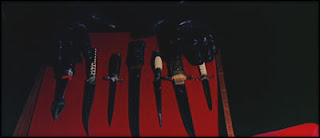
The movie opens with a figure garbed in a black plastic raincoat, black leather gloves and black hat lingering fetishistically over a series of wicked-looking hunting knives in a red velvet-lined case, then stalking and photographic a young woman before killing her. It's a pretty standard opening for a giallo, and most people probably forget it happens because two scenes later there is an astonishing setpiece that sets the tone not just for the movie, but for Dario Argento's entire career.

One alternate title for this movie was 'The Sadist with Black Gloves'

Sam Dalmas, an American trying to solve his writer's block with a holiday in Rome, sees two figures struggling over a knife in an art gallery - one a woman, the other dressed in black plastic raincoat, black leather gloves and black hat. He rushes to help but becomes trapped between two sets of glass doors, unable to get into the gallery or back out to the street. He watches helplessly as the figure in black flees and the woman, having been stabbed in the stomach, crawls across the floor in agony.

Eva Renzi

The woman survives, and when the police question Sam he is certain that he's seen a crucial clue but he can't quite remember what it is. When the police take away his passport to retain him as a witness, believing the attack to be only the latest in a series of attacks by a serial killer, he decides that he really needs to solve the murders himself.

Something that tends to strike people who see this movie after a number of Argento's later works is how tightly plotted it is. His later movies - especially from Suspiria onwards - often feature stories that are either impossibly convoluted (e.g. Tenebre) or downright nonsensical (particularly Phenomena). But at this stage of his career Argento regarded himself as a writer rather than as a director, and apparently only insisted on directing this one because he was sick of seeing other directors ruin his scripts. (One hopes he was at least satisfied with Sergio Leone's handling of Once Upon a Time in the West, which he co-wrote with Bernardo Bertolucci).

Given this, while I've always been quite cavalier about throwing around blatant spoilers on this blog, The Bird with the Crystal Plumage is a pretty great murder mystery and if you haven't seen it you really should go out and rent it, then come back here and read the rest of this. It's now easily available on DVD in most territories, so you shouldn't have any trouble finding it.

If you've seen the movie, or don't give a damn if I ruin the ending, then read on. I'll be talking about the identity of the killer before I reach the end of the synopsis, so don't say I didn't warn you. Now let's go on...

The Bird with the Crystal Plumage was one of the most crucial movies in that very particular Italian subgenre known as the giallo. Named for the colour of mystery paperback covers, a giallo started off just as an Italian murder mystery in which a good percentage of the characters are offed by a killer, usually motivated by greed. The great horror director Mario Bava is usually credited with the first giallo movies, The Girl Who Knew Too Much and Blood and Black Lace, and the latter film in particular was a huge influence of Argento's first movie; Blood and Black Lace's killer dresses almost identically to the one in Bird. But neither of Bava's movies was an international hit on the scale that Bird was to become, and so it was the latter movie that really established this as the costume of the giallo villain.

Hands of a director

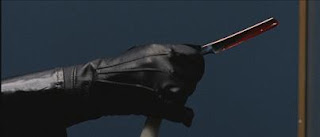
Argento's penchant for playing the gloved hands of the killer also started with this movie. This is one of the elements that earned him the reputation for being a misogynist, but it's more complicated than that. It's true that Argento identifies with his killers, and it's also true that many of the murders in his movies are highly sexualised and that the victims are usually beautiful women. Quotes like this one don't help either:

"I like women, especially beautiful ones. If they have a good face and figure, I would much prefer to watch them being murdered than an ugly woman or a man."

Poetry?

Which compares interestingly with this famous quote from Edgar Allan Poe:

"The death of a beautiful woman is, unquestionably, the most poetical topic in the world."

This particular woman, the lovely Suzy Kendall is not killed. She is also not mentioned elsewhere in this review. It's a shame.

I would argue that the key part of Argento's quote is right at the start. Any kind of careful viewing of his movies shows that he really loves women. I'll get more into this as we go through his filmography, especially one we get into the movies with female protagonists, but straight away in this one we have the simple example that Argento identifies very strongly with the killer - who turns out to be a woman. In fact, the killer turns out to be the victim from that key scene in the art gallery; the clue that Sam has missed is that the man in the raincoat was not attacking, but was in fact defending himself. The man was the killer's husband, who ends up confessing to the killings in order to protect his wife.

The real identity of the killer is revealed in a surprise ending. Unlike the gratuitous twists that modern filmgoers are used to, this one is actually the most important part of the story, and rewatching the movie knowing the ending is actually a lot of fun. Argento doesn't cheat the viewer; all the clues are there throughout.

One key image in this movie is a painting of a woman being brutally attacked. This painting depicts a long-suppressed trauma in the killer's life, and when she sees it she is tipped over into psychosis. As the movie's postscript (which amusingly, and slightly mockingly, pays homage to Psycho) explains, seeing the painting has somehow shifted her self-identification away from being the victim into being the attacker, compelling her to repeatedly re-enact her own attack from the other side.

I don't know about you, but this picture gives me the creeps

There's an odd sequence in this movie where a completely different killer shows up, played by the scary-looking Reggie Nalder. This killer uses a gun, and turns out to be a hitman hired by the main killer to eliminate Sam. I don't recall ever seeing another movie where a serial killer hires a hitman. Dealing with a serial killer turns out to be a bad idea, as Nalder later turns up dead himself.

Reggie Nalder was rarely described as handsome

Although Argento had never directed before, nothing about The Bird with the Crystal Plumage demonstrates any neophyte clumsiness. This might simply be down to the fact that he is surrounded by first-rate craftspeople; the cinematographer is Vittorio Storaro (Apocalypse Now, 1900), the music is by Ennio Morricone (who had already composed over a hundred scores, including all of Sergio Leone's westerns, and would go on to compose over three hundred more), etc. He had also grown up with the movies, as his father was a producer and his mother an actor, and before becoming a scriptwriter he was a film critic.

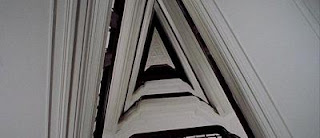
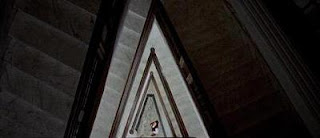
In any case, I'm sure that we can ascribe the beautiful look of the movie to Vittorio Storaro. Anyone who has only ever seen this movie on VHS really needs to check out the DVD as soon as possible.

Looking up...

...and looking down


A poster

Monday, August 2, 2010

New project: Dario Argento

It's time to start a new project, this time one with a rigorous schedule. I am going to watch and write about every movie directed by Dario Argento, at a rate of one per week, starting tomorrow, and in chronological order. So it's going to be Dario Argento Tuesday.


My first Dario Argento movie was Suspiria, and it changed the way that I look at movies forever. It taught me that a disregard for narrative and character does not need to be a flaw, and that all a movie need to do in order to be compelling is to present visuals and sounds in an intoxicating, thrilling manner. He has written and directed a good number of my absolute favourite movies, though his work in the last twenty years has been depressingly weak. The last few weeks of this project are likely to be quite depressing.

As well as the movies he has directed, I will be examining the movies he co-wrote and produced that were directed by his proteges. I'm also throwing in Dawn of the Dead on the grounds that he completely re-edited the movie for its European release, coming up with a version of the movie very different from the intentions of writer/director George A. Romero (though with Romero's permission and blessings).

Here is my schedule. I'll resist putting dates beside them just yet in case something dreadful happens to delay me, but there should be a new review each Tuesday. I'll put the links in here as the reviews go up.

The Bird with the Crystal Plumage (1970) - 3 August 2010

The Cat o' Nine Tails (1971) - 10 August 2010

Four Flies on Grey Velvet (1971)

Door Into Darkness: The Tram (1973, TV)

Door Into Darkness: Eyewitness (1973, TV)

The Five Days (1973)

Deep Red (1975)

Suspiria (1977)

Inferno (1980)

Tenebre (1982)

Phenomena (1985)

Demons (1985, producer/co-writer only)

Demons 2 (1986, producer/co-writer only)

Opera (1987)

The Church (1989, producer/co-writer only)

Two Evil Eyes: The Black Cat (1990)

The Sect (1991, producer/co-writer only)

Trauma (1993)

The Stendahl Syndrome (1996)

The Wax Mask (1997, producer/co-writer only)

The Phantom of the Opera (1998)

Sleepless (2001)

The Card Player (2004)

Do You Like Hitchcock? (2005)

Masters of Horror: Jenifer (2005, TV)

Masters of Horror: pelts (2006, TV)

The Mother of Tears (2007)

Giallo (2009)

Thursday, July 29, 2010

Amer (2009)

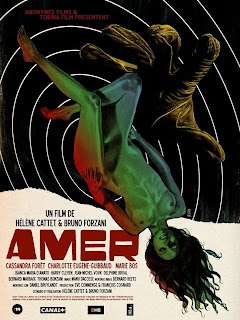
The best thing about this movie is its poster.

Pretty good, right?

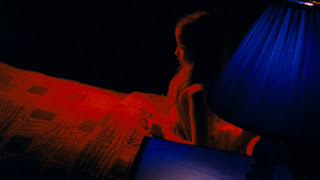
Amer uses the iconography of the giallo in service of a non-narrative art movie. It is extremely technically adept. The first third of the movie is a near-perfect synthesis of visual & aural ideas from Dario Argento's Suspiria and the "Drop of Water" sequence from Mario Bava's I Tre volti della paura. This segment follows a young girl as she attempts to steal her dead grandfather's pocket watch, while hiding in fear from her grandmother (who is portrayed very much as Helena Marcos from Suspiria). There is palpable tension throughout, with a series of vividly creepy images fractured through interesting editing.

Very clearly influenced by Suspiria

Unfortunately I was far less entranced with the second third of the movie, depicting the same girl as a teenager. This third was closer to Stan Brakhage in its extreme visual deconstruction, but without his intellectual rigour. The whole movie seems built around linking sex and death, a theme that's taken from many gialli but which is not developed in an interesting way here: a girl sees her parents making love while she is already in a state of fear and for the rest of her life equates sex with violence.

Something about this girl reminds me of a Svankmajer heroine

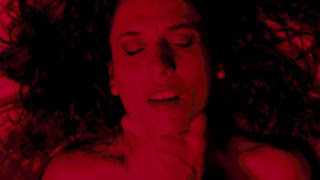
The final third of the movie depicts the same character as an adult, and returns to the more threatening tone of the first part of the movie. This is the part where the sexualisation of violence reaches its apex, and my interest was once again piqued. The movie comes full circle at this point: where the first segment features sex depicted as violence and death, the end features violence and death depicted as sex.

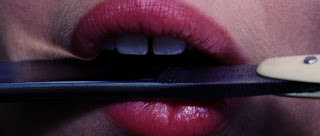
More Argento influence

It's just a shame that it was all so empty. If there was more to hang the movie on, or perhaps if the movie was half its present length, the impressive visual and aural techniques (the soundtrack inventively reuses giallo themes by Ennio Morricone, Bruno Nicolai and Stelvio Cipriani) wouldn't seem so much like a formalised experiment. The juxtaposition of sex and death is such a constant in the giallo (and in film in general) that just serving it up once again isn't enough on its own.

This probably sounds like a complete pan, but I actually quite enjoyed Amer. It absolutely nails the aesthetics of a good giallo, and it's a genre I have a lot of affinity for. I have absolutely no problem with style over substance, and I'm a fan of non-narrative film. I loved the homages to many individual movies throughout Amer - not just gialli but also things ranging from Un Chien Andalou to Jan Svankmajer's Down to the Cellar.

Amer is a feast for the senses, deeply sensual and arousing. I guess I'm a little confused by it - I'm tempted to go again to the Sunday session.

Sex and death are very interesting, don't you think?

Monday, July 26, 2010

The Guardian (1990)

Here we have a movie in which a dull American couple with a new baby hires an English nanny, which turns out to be a bad idea. Not just because, as the audience knows from a pre-credits sequence, this particular nanny has a penchant for sacrificing babies to a tree; but because their first reaction to having a child is to turn its care over to a complete stranger immediately.

At least the nanny loves her tree.

The movie actually opens with a disclaimer telling us that not all trees are evil. At first I thought this might be an in-joke, referring to the disclaimer before co-writer/director William Friedkin's earlier movie Cruising which started with a disclaimer stating that not all homosexuals are extreme S&M fetishist serial killers, but by the time the movie finished I was convinced that it was earnestly meant. This is an earnestly stupid movie.

Friedkin has made some terrific movies including The French Connection, To Live and Die in L.A. and (most relevant here) The Exorcist. The Guardian has no good dialogue, no good acting, weak cinematography, terrible music (by Jack Hues from '80s band Wang Chung) and a terrible story full of plot holes. Friedkin has said that the movie is an attempt to create a modern-day version of a Grimm's fairy tale, but it fails miserably in this respect as well. Even the gore scenes are dull.

The movie was originally by Stephen Volk (who also wrote the insane Ken Russell-directed Gothic, the silly but fun Joanna Pacula vehicle The Kiss, and Ghostwatch) and this is the worst movie I've seen from him. As his script was rewritten by Friedkin, I'm reluctant to pass any of the blame on to Volk.

The story involves a woman who is either a Druid or a tree-spirit (the movie seems a bit confused about this) who has to sacrifice babies to a malevolent tree for reasons that are unclear. The babies need to be less than 20 days old, or else their "baby genes" will have turned into "normal genes" and presumably the tree won't want them anymore.

In one of the more memorable scenes, she is hanging with the baby in the woods when three cartoonish rapists appear seemingly out of nowhere and threaten her with a big knife. She lures them to the tree, which then kills them in gruesome fashion. They are impaled, eaten (yes by a tree) and spontaneously combust. Later she goes back to the tree so it can heal the rather nasty stab wound she received during the fracas; it's unclear as to why she needs to leave and come back to do this, except that it allows an uninteresting minor character to follow her and see what she's up to, so that she can send her magic wolves to eat him.

I'm unsure why a tree spirit can command magic wolves, unless it's just to add to the supposed fairy-tale ambiance that the director needed to explicitly point out before I noticed that it was there.

There is a rather stupid scene where the father takes the baby and runs off into the woods while the nanny flies after him and the mother drives alongside in the family four-wheel drive. (Finally explaining why wealthy city & suburb dwellers drive those sorts of vehicles - I guess the fear of tree-worshipping nannies is more prevalent than I had assumed.) It concludes with her driving her car full-force into the nanny, who slams into the tree and seemingly dies. The parents are then furious when the cop on the case (played by the irritating husband from Candyman don't take their story seriously.

The finale of the movie involves the mother fighting the nanny for the baby while the father goes at the tree with a chainsaw. When the father cuts off a tree limb, the nanny's leg falls off. That was the best part of the entire movie - an unintentional laugh.

This movie, in case I have not been clear enough, is quite aggressively bad. It is not so-bad-it's-good, nor is there a case for critical appraisal. I fell asleep the first time I tried to watch it.

Also, what the hell is up with evil trees in horror movies? I've already written about Poltergeist but off the top of my head I can also think of The Woods, Evil Dead & Evil Dead 2 and From Hell It Came, and I'm sure there's plenty more.

If you want a good Grimm's fairy tale for adults movie, see A Company of Wolves (directed by Neil Jordan, based on stories from The Bloody Chamber by Angela Carter).

Can't be bothered with screen shots for this one

Monday, July 19, 2010

Blacula (1972)

Our movie opens in Transylvania, 1780. Prince Mamuwalde (William Marshall) and his wife Luva (Vonetta McGee) are the guests of Count Dracula (Charles Macaulay). Over dinner, they attempt to convince the Count to join their mission to abolish the slave trade. As well as being an undead fiend who feasts on the blood of the living, Dracula turns out to be a racist. After taking time out to mock and insult Manuwalde and Luva, he bites Mamuwalde, turns him into a vampire, locks him into a stone coffin, and seals up Luva in the same chamber to die...

Blacula sleeps

In the early 1970s American movie studios woke up to the fact that although they had a long history of exploiting black people, and an equally long history of exploiting audiences, it had never really occurred to them to exploit black people as an audience. Writer/producer/composer/director/star Melvin van Peebles showed the way with his independent movie Sweet Sweetback's Baadasssss Song, which made a huge amount of money for him and co-financier Bill Cosby. MGM "legitimized" the trend with Shaft, an even bigger hit with the added bonus of a smash-hit award-winning soundtrack album. Suddenly every producer in town wanted a movie about a cool black dude who beats up honkies to a hot funk beat.

In an always-racially charged country going through a particularly stressful time, a prominent black cinema could have offered a chance for expression. As is so often the case with a new trend, the first wave of movies out the gate were exploitative and often unpolished. Many of these movies were consciously made with mostly black crews, who had been locked out of the unions until very shortly beforehand. Because of this there was a dearth of experienced black talent. The first wave of blaxploitation movies (as they came to be known) offered a training ground for a new black cinema.

There should have been a renaissance of black-led cinema at this point, but an unfortunate series of events prevented this. The first was simply that audiences tired of the movies becoming too formulaic. At first the mere depiction of the black experience onscreen was considered to be a revelation; a number of people have written about how it felt to see Richard Roundtree being unable to hail a cab at the start of Shaft because nobody would stop for a black man. Black leads had been incredibly rare until then (just look at how everybody still points at Night of the Living Dead, from 1968, as being a real marvel because its lead role just happened to be played by a black man - the idea that a character could be written without any regard to race and then cast as black was completely unheard of before this). There was an element of overcompensation to many of these heroes: Sweet Sweetback floored many people just because the hero actually survived past the end of the movie, but later movies would feature leads who were effectively superheroes. But when people eventually tired of this specific portrayal of black characters in movies, producers interpreted it as meaning that audiences were tired of black-oriented movies.

Another factor was from pressure groups (particularly the NAACP, the Urban League and the Southern Christian Leadership Conference, who joined forces to form the Coalition Against Blaxploitation) who were dissatisfied with the portrayal of black people in blaxploitation movies. They did have a point, as a number of the most prominent movies featured pimps and drug dealers as heroes, although this was not true across the board. But this controversy, combined with audience drop-off and the (mostly white) producers' failure of imagination, lead to the cycle being shut down pretty quickly. No new attempts to reach a black audience were made, except by a handful of (mostly black) independents, and the cliché of "the black character dies first" picked up where it left off. The next wave of black filmmaking didn't really take hold for over ten years, with actors like Eddie Murphy and directors like Spike Lee breaking into the studio system on their own terms.

All of which is, I think, much more interesting than the movie currently under discussion, but let's get back to that anyway.

After a fun animated opening credits sequence involving a bat chasing a woman (see the YouTube video at the bottom of this review), we cut to 1972 where two gay-stereotype interior decorators have bought the entire contents of Dracula's castle, including Mamuwalde's coffin. When they break it open,he promptly bites them and escapes. Before long he runs into Tina (McGee again) and realises that she is the reincarnation of Luva.

Blacula gets some

Mamuwalde divides his evenings between romancing Tina (who doesn't need much convincing about the reincarnation idea, and who is remarkably calm upon learning that her beau is a vampire) and biting more people. He wants to turn Tina into a vampire so the two of them can be together forever, but he only wants her to come willingly. As played by William Marshall, a very tall actor with a Shakespearean background, Mamuwalde is an old-school gentleman with impeccable manners, charm and style. Though he is slightly out of place in 1972 (as one guy keeps saying, "That is one straaange dude!") he seems to adapt to the modern world with no difficulty at all.

The modern world

He also has no problem with killing white cops who would shoot an unarmed black person in the back. This is really the only way in which he is a typical blaxploitation character.

Mamuwalde's nemesis is Dr. Gordon Thomas, a forensic scientist working with the police who was a friend of one of the interior decorators. Dr. Thomas is another atypical character for the genre - he's not a criminal and he's not precisely a cop. He's also highly educated, intuitive, and figures out that Mamuwalde is a vampire who's killing people very quickly. Unlike many vampire hunters in movies he doesn't run off at the mouth about his theories and get judged as a nutcase, but gathers actual incontrovertible evidence that he can present to his white cop buddy to gain the support of the police force.

Inevitably, things do not go well for Mamuwalde and Tina/Luva. After she is shot in the back by a white cop while unarmed and running away, Mamuwalde is compelled to bite her in order to save her life. Unfortunately she is swiftly staked by Dr. Thomas's white cop buddy. All the fight goes out of Mamuwalde at this point, as he considered her to be the only thing worth living for. He goes up onto the roof, exposing himself to the sun, and melts away to a skeleton in a nicely disgusting worm-eaten finale.

The death of Blacula

Blacula was the first blaxploitation movie to move away from the action genre. It takes a similar idea to the same year's Dracula AD 1972 in bringing the story of Dracula (if not the character, in this instance) into a contemporary setting. The Hammer movie was a lot more polished, but Blacula is more in touch with its time; where Hammer made a movie that was so self-consciously modernised that it instantly became a period piece, Blacula is just a movie that's typical of its milieu.

I'm spending a lot of time avoiding the point here: Blacula is a bad movie. It's one of those movies where you can see the blocking. The cinematography is borderline inept, and there's no atmosphere to the movie at all. The acting ranges from competent to dreadful, with Marshall the one notable exception. The music (by Gene Page) is far from the best that the genre has to offer, though the musical interludes in the club are fun. The script is terrible, as is the pacing. None of this stops the movie from being perfectly entertaining, especially if you're a fan of cheesy low-budget horror movies or blaxploitation.

Lead actress Vonetta McGee sadly died ten days ago, so I'm not pleased to report that she is the worst actor in the movie. She looks lovely, but she's completely wooden. William Marshall, on the other hand, is terrific as Mamuwalde. Marshall has a deep and very theatrical voice, and is completely convincing as an essentially good-hearted aristocrat who loathes what he has been turned into. He is commanding and dignified, though his dignity is slightly dented by the silly vampire makeup he wears in a few scenes.

This is a movie that the Coalition Against Blaxploitation would probably have had little problem with. None of the characters are pimps, drug dealers or criminals. The villain, though black, is portrayed with dignity and his villainy stems from being infected with vampirism by a white racist. The hero, also black, is a forensic scientist whose white cop buddy is deferential towards him. It also features strong anti-racist rhetoric, though mostly in the pre-credits sequence.

If you want to see a cheesy horror movie packed with early '70s decor, fashion and music, Blacula should fit the bill nicely. If you want a good movie, best to keep moving.

As for the Dracula factor, the appearance of Dracula himself is not inconsistent with the novel or with other portrayals. As the pre-credits sequence is set a hundred years before Bram Stoker's novel, the idea of Dracula as an internationally-known dignitary is not completely unreasonable. His treatment of Mamuwalde is reminiscent of the legend about Vlad Tepes (Dracula's main inspiration) where, when foreign ambassadors refused to remove their hats for cultural reasons, he ordered them nailed to their heads. And given the nationalistic fervour he has in the novel, it's not at all surprising that he's hideously racist.

Dracula: Prince of Racists

The theme of a vampire encountering a reincarnation of his lost love centuries later was later used in two Dracula movies I know of, the 1973 tv movie written by Richard Matheson and starring Jack Palance, and the 1992 movie directed by Francis Ford Coppola and starring Gary Oldman. I'm sure that it must have appeared earlier than in Blacula but nothing immediately comes to mind.

I'm planning to watch the sequel Scream, Blacula, Scream soon, but I'm unsure as to whether it actually counts as a Dracula movie. Given that Dracula himself appears in this first movie (but presumably not in the second) and that Blacula is a racist epithet bestowed on him rather than his name, I'm reluctant to view Mamuwalde as a Dracul substitute. He's far too distinct a character in his own right anyway. But what do other people think?

This is the trailer, showing most of the 'best' scenes:


This is the fun opening credits sequence, featuring Gene Page's theme music:


Rar!

Monday, July 12, 2010

Seven Deaths in the Cat's Eye (1973)

When it comes to late-night escapism, I have a particular love of Italian movies involving beautiful women solving mysteries in crumbling castles while the bodies pile up around them. Antonio Margheriti's 1973 giallo Seven Deaths in the Cat's Eye has all of the ingredients I'm looking for and more. The presence of Jane Birkin in the lead role certainly helps, but I think it was the gratuitous gorilla that really sold me on this one.

Peek-a-boo

Corringa (Jane Birkin) has just arrived at Dragonstone, her family's castle in Scotland, to find that all is not well. Her aunt Lady Mary MacGrieff (Françoise Christophe) has been unsuccessfuly trying to get a loan from Corringa's mother Lady Alicia (Dana Ghia) so she can afford to hold on to the castle, for the good of the family name of course. Lady Mary's son James (Hiram Keller) spends all of his time insulting the guests, wandering through secret passages, and looking after his pet gorilla. Dr. Franz (Anton Diffring) explains that James has not been right in the head since he murdered his baby sister when they were children.

Meanwhile, nobody seems to know about the rat-eaten corpse in the cellar except for a very fat ginger cat that also conveniently manages to be present every time one of the guests is murdered...

Peek-a-boo

Seven Deaths in the Cat's Eye is a hybrid of several subgenres, mostly giallo and gothic horror, with elements of the German krimi movies thrown in. Early on there are whispers of a vampiric curse, where if one family member murders another they will rise from the grave as a vampire to seek revenge, but this mostly just prompts a vivid dream sequence where Corringa dreams that her mother is urging her to avenge her death. All other hints of the supernatural turn out to be red herrings, as does the gorilla.

Vampire dreams

Jane Birkin's then-husband and frequent collaborator Serge Gainsbourg turns up as a police inspector with a talent for turning up at the most inconvenient times. Thanks to the miracles of dubbing, we get the bizarre spectacle of France's greatest popular musician speaking in a broad Scottish brogue. Gainsbourg's unnamed inspector is unusually sharp for a cop in an Italian horror movie; not only does he put together the solution to the case before anyone else, he deservedly gets the last word in the movie, and manages to save a couple of lives to boot.

Jane Birkin and Serge Gainsbourg

Not too many lives though. This is a giallo first and foremost, and it wouldn't work out too well if there weren't a string of colourful murders. Even the poor gorilla gets it in the neck.

I thoroughly enjoyed Seven Deaths in the Cat's Eye, though I have to admit it was a pretty terrible movie in most respects. It is reasonably nicely shot, filled with fairly reliable European character actors (Luciano Pigozzi, the Italian equivalent to Peter Lorre, shows up just long enough to get his throat cut), and it has no shortage of silly goings on.

Typical Italian horror movie coloured lighting

If you're a fan of this sort of thing already, there are far worse movies you can watch. If you're a newcomer to Italian horror movies, this is not the place to start.


The lovely Jane Birkin and friend