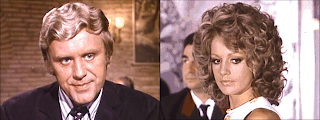
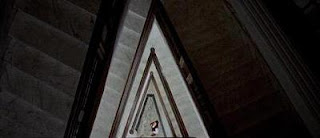
"El sueño de la razón produce monstruos" - Goya
When I was a child in the early 1980s, I used to look at the video covers of horror movies with a mixture of trepidation, awe and covetousness. I knew that if I ever managed to get my grubby little hands on the actual tapes, I would witness a universe of unparalleled depravity and gore, in which horrible things would constantly be happening to people for no reason at all while the souls of the damned howled torturously on the soundtrack. These video covers frightened the hell out of me, and I couldn't wait to see the pure, unadulterated real thing.
Of course, when I actually started watching the movies whose covers had such a huge impact on me I couldn't help but be disappointed. The Deadly Spawn, Boarding House, The Burning - not only were they massively over-sold by their posters and video covers,, the copies I managed to see were often cut versions that had came to New Zealand via the censors in Australia or the UK. Worse, many of the movies that really would have had a strong impact on me if I'd managed to see them - The Texas Chainsaw Massacre, The Hills Have Eyes, Eaten Alive etc - had completely vanished from the shelves, some the victims of NZ's new video censorship laws and others simply played to death.
It was a while before I saw anything that came close to my initial imaginings of what a horror movie must be like. The first was the legendary first twenty minutes of Dario Argento's Suspiria, and the second was the last sixty minutes of Sam Raimi's The Evil Dead. But the movie that came closest to my childhood dreams was a peripheral movie from the Argento stable, Demons
At first glance, all Demons wants to do is run around screaming and biting people on the throat and gouging out their eyes. That's all I got from it on my first few viewings, and I was perfectly happy with it. But this time around I've realised that there's something going on beneath the skin, something that's threatening to swell and burst and splatter green goo over everything.
The story of Demons is really something. It opens with Cheryl (Natasha Hovey), a music student, taking a train to Berlin on her way to university. She starts getting glimpses of a sinister masked man (Michele Soavi), who then stalks her through the subway... in order to give her a free movie ticket. She convinces her friend Kathy (Paola Cozzo) to bunk off school and take in the movie. At the theatre, they encounter an amusingly diverse crowd.
First and most fun are Tony the pimp (Bobby Rhodes) and two sex workers, Rosemary (Geretta Geretta) and Carmen (Fabiola Toledo). While they clown around, Rosemary takes a silver demon mask (reminiscent of the one worn by the subway stalker at the start) and tries it on, cutting her face in the process. There's also Werner (Alex Serra) and his daughter Liz (Bettina Ciampolini); as Werner is blind, he relies on Liz to describe the movie for him as they watch it. Liz takes the opportunity to secretly make out with her lover (Claudio Spadaro) while Werner is oblivious. Two young guys, George (Urbano Berberini) and Ken (Karl Zinny) take a shine to Cheryl and Kathy and decide to limpet themselves to the reluctant young women. The rest of the audience is fairly anonymous, though it also includes Fiore Argento, daughter of Dario and half-sister of Asia.
Once everyone has taken their seats, the movie begins. Of course, it turns out to be a horror movie. It tells the story of a group of young people who break into Nostradamus's tomb in the middle of the night, where they find a prophecy about how the world will be overrun by demons. One of them (Michele Soavi - the same actor who played the masked man at the start) finds a demon mask and puts it on, despite his friend's warning that anyone who wears the mask will become a demon.
Just as this happens, Rosemary finds that the cut on her face from the mask in the lobby has started to bleed again. She heads to the bathroom to get cleaned up, and is understandably distressed when she finds that the cut has swollen to a boil, which bursts and splatters green goo everywhere. Soon Carmen goes to find her friend, only to discover that - just like the guy in the movie - Rosemary has changed into a demon. She slashes Carmen's face and they both run off. Soon Carmen finds herself trapped behind the movie screen as her own injury starts to swell and burst. She pushes her way through the screen, transforming into a demon as she does, and in this way the movie quite literally bursts into the audience.
It's at this point that Demons goes absolutely nuts. After a spectacular on-screen transformation Carmen starts slaughtering people at the front of the auditorium, while a gleefully cackling Rosemary runs in from the back and starts creatively killing everyone she sees. The soundtrack thunders with '80s heavy metal, and everybody runs around screaming, especially once they discover that the exits have all been bricked up and they are all trapped in the theatre. Anyone who is wounded by a demon becomes a demon themselves, sooner or later. The movie immediately degenerates into a delirious orgy of violence and gore from which it never returns. Obviously, I am using the word "degenerates" as a compliment.
Meanwhile, a carload of young punks are driving around snorting cocaine out of a Coke can. They bicker amongst themselves childishly and throw tantrums when one of them spills the coke. They don't seem to have anything to do with anything until they attract the attention of the police, and end up ducking into the Metropol through a side entrance, which they leave ajar. As they go in, something sneaks out...
Horror is perhaps the most self-referential of all movie genres, and horror movie aficionados tend to be unusually film literate. The movie references in Demons are even deeper and more multi-layered than is usual in the genre. The concept of a horror-film-within-a-film influencing events in the "real" world is quite common (see such movies as Bigas Luna's remarkable Anguish, the so-so Popcorn or John Carpenter's In the Mouth of Madness, for example), but none of them take the theme quite as far as Demons.
The masks seen in the movie, which seemingly cause the demon plague, are similar to those seen in The Mask of Satan, the first great Italian horror movie, directed by Mario Bava, the father of Demons director Lamberto Bava. In Bava Sr.'s film, the masks have spikes on the inside and are nailed to the faces of the movie's villains; in Bava Jr.'s film, it is a cut on the face from the inside of the mask that causes the demon plague.
The name of the theatre, Metropol, alludes both to an actual famous Berlin cinema and to Fritz Lang's 1927 expressionist film Metropolis; there is also a poster for Metropolis seen in the theatre. Germany is, of course, the original home of the horror movie thanks to expressionistic movies like The Cabinet of Dr. Caligari and Nosferatu. There is also a poster for Werner Herzog's 1979 remake of Nosferatu in the Metropol, bringing the expressionistic horror movie closer to the present, as well as an in-joke poster for co-writer/producer Dario Argento's movie Four Flies on Grey Velvet. (There are also posters for Paul Newman's uninteresting Harry & Son, for the anti-nuclear weapons concert movie No Nukes, and for the Australian band AC/DC, whose music the filmmakers probably wanted to use.)
The casting of a grown-up Nicoletta Elmi as the Metropol's usherette Ingrid is a multi-layered reference in itself. Although only about twenty at the time, Elmi was an Italian horror movie
veteran, having started her career in Mario Bava's Twitch of the Death Nerve in 1972 [*]. Elmi's biggest impression before Demons was probably in her small role as a sadistic child in Dario Argento's Deep Red,
though she also appeared in such gems as Paul Morrissey's Flesh for Frankenstein and Aldo Lado's Who Saw Her Die? She hadn't been visible in the genre for almost ten years, but she had retained her distinctive looks as she grew up, and although Ingrid is a bit of a red herring, Elmi's sinister (and now also sexy) presence confirms that the characters are definitely trapped in an Italian horror movie.
In the movie within the movie (which I don't think is ever given a title) the actor who wears the demon mask and cuts himself on it is the same actor who plays the masked man handing out free tickets at the start of Demons. Soavi also worked behind the scenes as Lamberto Bava's Assistant Director, a position he had also held on previous Bava and Dario Argento movies. While working on Demons he also filmed behind-the-scenes footage for a documentary called Dario Argento's World of Horror, in which he deliberately turns his camera to a mirror and films himself and his camera to accompany his own directorial credit. Somehow, Soavi also found time to film a music video for Claudio Simonetti's theme music.
Along with the aforementioned mask, the other props from the movie-within-the-movie that we see in the lobby are a motorcycle and a samurai sword. Towards the end of the movie, one of the heroes leaps on the bike, grabs the sword, and starts hooning around the theatre cutting demons to shreds. In this scene, it's not just the evil that's come out of the movie but also a means of curtailing it.
And of course in the scene where Carmen is infected, she finds herself pushing through series after series of red curtains - a recurring Dario Argento image from movies like Deep Red and Opera, usually signifying the beginning of the journey into horror - and finds herself behind the movie screen itself. As she starts to transform into a demon, her screams mingle with those of the movie until she finally rips through the screen itself. This scene was copied in the 2012 movie Gangster Squad, in a scene that appeared in the trailer but was ultimately cut out of the movie beause of concerns about a real-life mass murder in a screening of The Dark Knight Rises. [**] It is also reminiscent of a scene in the same year's The Purple Rose of Cairo, written & directed by Woody Allen, in which a character steps out of a movie into the audience.
Apart from its surprising metatextual sophistication, there is a lot to enjoy about Demons just in the realms of good dumb fun. There are many excellent transformation and gore effects by Sergio Stivaletti, on only his second movie, which still impress today; in particular the elaborate transformation of Carmen still looks amazing. The whole cast gives amusingly over-the-top performances, in particular Bobby Rhodes as Tony the pimp and Geretta Geretta as Rosemary, the lead demon. The seemingly unrelated scenes of the coked-up punks driving around Italy offer their own kind of dumb fun. The unexpected arrival of a helicopter at a pivotal moment is cited by some as being the best moment in the entire movie, and the amazing apocalyptic ending (which features another cameo from a distinctive young horror veteran, Giovanni Frezza from Lucio Fulci's The House by the Cemetery and Manhattan Baby, among others) sends the movie off on a high note.
There are also a few unexpected and effective moments of quiet horror. Many people point to the scenes of the demons prowling the corridors with glowing eyes, but I would single out the beginnign of Kathy's transformation as my favourite creepy moment in the entire movie. Having stumbled through the previous scene in a state of shock, Kathy looks up at Cheryl and asks in a distinctively different accent to the one she's used in the rest of the movie, "This place... Where am I?" and then, as her eyes turn red, "Who are you?" The implication that the demons may be rational creatures driven to insane bloodlust as they come into our world is nicely disturbing. Of course, the horned demon that bursts impossibly out of Kathy's back moments later is pretty cool as well.
On the downside, most of the female roles are pretty weak. Not that Demons is a movie with well-written male characters, as characterisation is pretty much beside the point here, but all of the women in the movie basically scream and cry while the male characters tell them to pull themselves together. Horror is one of the few genres which regularly presents women as strong and capable, so it's a shame to see Demons letting the side down. Other than that, unless you're going to carp about the plot being weak - which is also beside the point - or things not making much sense - which almost is the point, as the more "what the fuck?" moments are also the most fun - there's nothing to complain about here.
I recommend Demons to anyone who likes wild & crazy horror movies. If you enjoyed the first two Evil Dead movies or Rec 3, this should be right up your alley. And what's more, there is a sequel that is just about as good as the original (as well as various fake sequels of wildly varying quality).
But that is another story...
[*] Bava Jr. worked as an assistant director on both Twitch of the Death Nerve and his father's next film, Baron Blood, which also featured Elmi. ^
[**] I actually saw this trailer before a screening of The Dark Knight Rises on the very night that the murders were committed - luckily not in the same theatre. ^
Showing posts with label Dario Argento. Show all posts
Tuesday, April 9, 2013
Tuesday, August 17, 2010
Four Flies on Grey Velvet (1972)
Roberto Tobias, a drummer in a rock band, has been noticing a man following him for about a week. When he sees the man late at night after a band practice, he follows and then confronts him in an abandoned theatre. The man pulls a switchblade, and in the struggle he is stabbed and seems to die. As Roberto stands over the body with the bloodied knife in his hand, a spotlight is turned on him from the gallery where a masked figure starts taking photographs of him. He flees, but soon he starts receiving packages from the mysterious witness - the dead man's wallet, photographs of the murder, and worse. He confesses everything to his wife Nina, who urges him to run away with her, but he refuses as he's scared that he'll end up in prison for murder. Then their maid discovers what's going on and tries blackmail; when she turns up dead it's clear that Roberto and Nina are caught in a trap that neither will be able to escape unscathed.

On the advice of his friend God (played by slapstick comedian Bud Spencer) Roberto hires Gianni Arrosio, a flamboyantly gay private investigator who swiftly manages to uncover the identity of the blackmailer. Poor Gianni should have realised that if you want to survive a murder mystery, you need to do that right at the end of the story...
This is a fascinating movie. In some ways it seems slapdash and inconsistent, and there are some dreadful comic relief bits that really don't work, but even these scenes are closely linked to the movie's thematic concerns. It has an elaborate visual style that at first seems gratuitous but which turns out to be centered around revealing the themes of the movie. The murder mystery itself is extremely difficult to work out, cheats several times and requires the killer to pretty much be a mind-reader, but its resolution really clarifies everything that the movie is doing.

It's very much the transitional movie between his first movies, which were stylish but very tightly written and plot-driven, into his later movies, which were much more personal and often abandoned conventional plotting in favour of his visual and thematic obsessions. This is blatantly signalled in the scene where Roberto enters the theatre at the start - the camera passes through several layers of deep red curtains, in anticipation of what was to be his breakthrough movie three years later...
In short, this is the movie which reveals that Dario Argento's main influence is less Alfred Hitchcock, as is commonly presumed, and more Michaelangelo Antonioni. It even references (and parodies) the ending of Zabriskie Point. This connection to Antonioni would become even more clear when he made Deep Red.... but we'll get to that in a few weeks.
Four Flies on Grey Velvet is a movie about gender, sexuality and repression; as with every Argento movie it's also about perception, and how what you see is not necessarily the truth. I'm going to give away a few salient points now (including the identity of the killer and what really happened in the opening scene) so if you haven't seen the movie and want to watch it without foreknowledge, now is the time to stop reading.
Watching Four Flies a second time was more interesting because knowing that the opening scene was a setup and that the "murder" was fakes with a trick knife and a blood bag, and that the killer is actually Nina, makes everything play very differently. As the final scene reveals, Nina was raised as a boy by an unhinged father, and is played by the androgynous American actress Mimsy Famer, who is spectacular in the role. This makes the scene where she kills Gianni in an unisex toilet very interesting; usually a scene of a gay man being killed in a toilet would seem homophobic, but not this time.

Gianni is actually the smartest and most sympathetic character in the whole movie, and although his mannerisms are rather stereotyped he is a vast improvement over the gay stereotypes in most movies of the period. Four Flies actually puts Argento at three for three in featuring sympathetic gay characters in his movies, after the art dealer in The Bird with the Crystal Plumage and the rude yet likable Dr. Braun in The Cat o' Nine Tails, and according to Argento's biographer Alan Jones he wanted to make a movie with only gay characters but the idea was vetoed by his producers.
Comic relief scenes involving a mailman delivering pornography to the wrong address are cringingly unfunny, but serve to highlight the sexuality/repression theme - especially as the person who receives them in error is a sexually repressed woman who is later revealed to be secretly in love with Roberto.
Speaking of Roberto, he is a very unlikable and even obnoxious character. After seemingly commiting murder, his only reaction is fear of being caught. He treats Nina very badly (which, as it turns out, plays directly into her obsessions) and thoughtlessly cheats on her with her young cousin. He lashes out at the mailman, mistaking him for the blackmailer and gives him a sound thrashing before realising his mistake.
Like Nina, Roberto is an androgynous figure, and despite the homophobia he displays upon first meeting Gianni (in a scene that playfully challenges the audience's own homophobia) many of his interactions with other male characters have a homoerotic subtext to him. It's interesting that, as played by David Brandon, he closely resembles Argento himself.
Nina's motivation for tormenting Roberto turns out to be very twisted indeed. She seduced and married him specifically because he bears a very close physical resemblence to her dead father. He had died while she was committed to a psychiatric institution, so she was looking for someone to torment and murder in his place. In the end, as she is about to kill him, he is saved by divine intervention as God actually bursts into the room and chases her off!

God himself is an interesting character. He's sourced from the novel The Screaming Mimi by Frederic Brown, which was the uncredited source material that The Bird with the Crystal Plumage had, er, borrowed from. He's a big burly man with a black beard who lives in a shack by the river and lives off raw fish. He's actually introduced with a chorus of "Hallelujah," in an example of the movie's ham-fisted sense of humour. Like many homeless people in movies, God is deeply philosophical. He has a sidekick called The Professor, who constantly quotes from the Bible. I must confess that I'm unsure of the exact significance of these irreverently religious figures.
Four Flies on Grey Velvet stretches this kind of giallo about as far as it can go. It's pretty clear that Argento was unlikely to want to continue in this vein, and with his next movie he moved out of the thriller genre entirely for the only time in his career to date, with the spectacularly unsuccessful The Five Days. However first he was engaged to produce and host a series of four thrillers for the Italian television netowkr RAI, called The Door Into Darkness, and ended up writing and directing two of these himself. In the manner of Alfred Hitchcock Presents, these were to make Argento into a genuine star in his own country, and we'll look at the first of these next week - The Tram, which was actually based on an episode he cut out of the script of his first movie.
Tuesday, August 10, 2010
The Cat o' Nine Tails (1971)
A middle-aged blind man and a young girl overhear a snatch of a conversation involving blackmail. Soon they discover that it involves a break-in at a prestigious medical institution. They start investigating, with the help of a journalist, and soon the bodies are piling up.
The Cat o' Nine Tails is a fairly standard murder mystery, co-written and directed by Dario Argento, who seems determined to set it apart from his previous movie, The Bird with the Crystal Plumage. Unfortunately what he has mostly done is to remove all of the most interesting and distinctive elements. Without Argento's trademark obsessions, and with a far less distinctive mise-en-scène, what's left is mostly a fun but forgettable giallo. There are plenty of twists and turns and an amazing amount of red herrings, but nothing that really gets its fish-hooks into you.
There are still some points of interest, both conceptually and visually, and they mostly have to do with the theme of perception that runs through many of Argento's movies. This one is very concerned with the eye. Arno is blind, and when not wearing dark glasses Karl Malden is very good at suggesting this with a far-away stare. The presence of the killer is always signaled by huge closeups of his retina. A key clue is provided by a photograph which is incomplete; the full version contains a clue at the very edge of the frame - at the edge of perception.

Some bizarre editing also adds to the fun. Most intriguing is the scene towards the start where the break-in occurs. We are watching Arno assemble a crossword puzzle (he has an interesting braille device for doing so) when suddenly we start getting quick cuts of the break-in in progress. Arno looks alarmed and goes to check on Lori (the young girl under his care - we never find out the precise nature of their relationship) before opening the window and "looking" out. His apartment overlooks the Institute - but of course he cannot see anything. The killer, having just dispatched the night watchman, looks up just in time to see Arno's shutters closing again.
This sequence strongly implies a psychic vision, as if Arno's lack of sight has opened up other avenues of perception, but it is never referred to again. But it's an interesting first glimps; psychic powers would become important in some of Argento's later movies.
That relationship between Lori and Arno (who she called Cookie "because he's sweet") is vaguely troubling. Arno says that he has no relatives and she has no parents so they need each other. Is he her uncle, the brother of one of her dead parents? He's been blind for 15 years and she is well under 15 eyars old; who decided that a blind bachelor would be the best person to raise a young girl? There's a lot of physical affection between them, most of it from him; it could all be seen as innocent, but later in the movie we find out that two other characters who are father & daughter by adoption are in a sexual relationship.

It grows even more troubling when you look at Dario Argento's strange screen relationship with his oldest daughter Asia (who was not yet born when Cat o' Nine Tails was made), and it certainly adds something disturbing to the movie.
There are red herrings galore, and almost every character is a suspect at one point or another. The chief suspect, almost from the beginning, is Dr. Braun, a German scientist who is blunt, rude and (it is eventually revealed) homosexual. Gay characters tended to be villains in movies like this, and when the idea of the killer having a chromosonal imbalance (the dreaded XYY, which had already been dragged out in movies like Twisted Nerve) is revealed the audience is lead to believe that Braun is the most likely culprit. However the movie presents its gay characters with more respect than is normal in a movie of its vintage, as was the case with the gay art dealer in The Bird with the Crystal Plumage. They are still clichés, but at least they are sympathetic clichés.
The cinematography is by Erico Menczer, who is a craftsperson where Bird cinemotographer Vittorio Storaro is an artist. There are still some cool shots of staircases, and the camera prowls restlessly in some scenes, but the startling compositions of the earlier movie are missed.
Fortunately the soundtrack by Ennio Morricone is top-notch. Working with orchestrator Bruno Nicolai, as he usually did when scoring a giallo, Morricone provides a score driven by an ominous pulsing bassline that helps to propel the movie forward. A good amount of the movie's atmosphere is provided by this score.
The acting is good throughout. Karl Malden is great fun as Arno, and James Franciscus is solid as reporter Giordani. Eurohorror mainstay Rada Rassimov has a good role the fianceé of one of the victims, though Catherine Spaak's role as the daughter of the Institute's head is under-written, though she does get to drive like an absolute maniac in one terrific scene. Best of all is Horst Frank, clearly relishing his role as Dr. Braun. Spaak and Horst also have amazing early '70s hair.

One big downside to the movie, though, is that the main characters are basically nosy bystanders. In almost every other Dario Argento movie, the protagonist is inexorably drawn to the murders so that it becomes an obsession. In this case we have a reporter trying to get a story and a guy who "likes puzzles". The personal involvement is deeply missed.
The other main downside, other than the lack of visual splendour, is that the murder setpieces are not very interesting. Apart from one great scene involving murder by train (which has a great cynical topper when the reporters abandon photographing the gruesome body to concentrate on a starlet who has arrived on the same train) they are mostly a series of unconvincing garrottings. Some murders even happen off-screen. Given that the murder scenes are where Argento's movies usually excel, this is very disappointing.

The movie is also quite frigid, possibly because Argento usually does express sex through violence in his movies. There is one sex scene, and it's startlingly cold and unerotic. This might be partially because there's no obvious chemistry between James Franciscus and Catherine Spaak, but it's also filmed in a startlingly cold manner. I suspect that Argento simply had no idea how to film a normal sex scene.

I have to say, though, that the ending is wonderful. It takes place on a rooftop, with both of our heroes individually confronting the killer. I won't give it away except to say that it refuses to play it safe, with at least two characters left with an ambiguous fate. There seems to be an implication that with all the different cans of worms that Arno and Giordani have opened, even the apprehension of the killer won't contain the chaos that has been unleashed.
If you compare Cat o' Nine Tails to a giallo from, say, Umberto Lenzi or Sergio Martino, it looks pretty good. If you compare it to the movie Argento had just made, and to the other gialli he made in the 1970s, it looks pretty weak. It's all a matter of perception.
The Cat o' Nine Tails is a fairly standard murder mystery, co-written and directed by Dario Argento, who seems determined to set it apart from his previous movie, The Bird with the Crystal Plumage. Unfortunately what he has mostly done is to remove all of the most interesting and distinctive elements. Without Argento's trademark obsessions, and with a far less distinctive mise-en-scène, what's left is mostly a fun but forgettable giallo. There are plenty of twists and turns and an amazing amount of red herrings, but nothing that really gets its fish-hooks into you.
There are still some points of interest, both conceptually and visually, and they mostly have to do with the theme of perception that runs through many of Argento's movies. This one is very concerned with the eye. Arno is blind, and when not wearing dark glasses Karl Malden is very good at suggesting this with a far-away stare. The presence of the killer is always signaled by huge closeups of his retina. A key clue is provided by a photograph which is incomplete; the full version contains a clue at the very edge of the frame - at the edge of perception.
Some bizarre editing also adds to the fun. Most intriguing is the scene towards the start where the break-in occurs. We are watching Arno assemble a crossword puzzle (he has an interesting braille device for doing so) when suddenly we start getting quick cuts of the break-in in progress. Arno looks alarmed and goes to check on Lori (the young girl under his care - we never find out the precise nature of their relationship) before opening the window and "looking" out. His apartment overlooks the Institute - but of course he cannot see anything. The killer, having just dispatched the night watchman, looks up just in time to see Arno's shutters closing again.
This sequence strongly implies a psychic vision, as if Arno's lack of sight has opened up other avenues of perception, but it is never referred to again. But it's an interesting first glimps; psychic powers would become important in some of Argento's later movies.
That relationship between Lori and Arno (who she called Cookie "because he's sweet") is vaguely troubling. Arno says that he has no relatives and she has no parents so they need each other. Is he her uncle, the brother of one of her dead parents? He's been blind for 15 years and she is well under 15 eyars old; who decided that a blind bachelor would be the best person to raise a young girl? There's a lot of physical affection between them, most of it from him; it could all be seen as innocent, but later in the movie we find out that two other characters who are father & daughter by adoption are in a sexual relationship.

It grows even more troubling when you look at Dario Argento's strange screen relationship with his oldest daughter Asia (who was not yet born when Cat o' Nine Tails was made), and it certainly adds something disturbing to the movie.
There are red herrings galore, and almost every character is a suspect at one point or another. The chief suspect, almost from the beginning, is Dr. Braun, a German scientist who is blunt, rude and (it is eventually revealed) homosexual. Gay characters tended to be villains in movies like this, and when the idea of the killer having a chromosonal imbalance (the dreaded XYY, which had already been dragged out in movies like Twisted Nerve) is revealed the audience is lead to believe that Braun is the most likely culprit. However the movie presents its gay characters with more respect than is normal in a movie of its vintage, as was the case with the gay art dealer in The Bird with the Crystal Plumage. They are still clichés, but at least they are sympathetic clichés.
The cinematography is by Erico Menczer, who is a craftsperson where Bird cinemotographer Vittorio Storaro is an artist. There are still some cool shots of staircases, and the camera prowls restlessly in some scenes, but the startling compositions of the earlier movie are missed.
Fortunately the soundtrack by Ennio Morricone is top-notch. Working with orchestrator Bruno Nicolai, as he usually did when scoring a giallo, Morricone provides a score driven by an ominous pulsing bassline that helps to propel the movie forward. A good amount of the movie's atmosphere is provided by this score.
The acting is good throughout. Karl Malden is great fun as Arno, and James Franciscus is solid as reporter Giordani. Eurohorror mainstay Rada Rassimov has a good role the fianceé of one of the victims, though Catherine Spaak's role as the daughter of the Institute's head is under-written, though she does get to drive like an absolute maniac in one terrific scene. Best of all is Horst Frank, clearly relishing his role as Dr. Braun. Spaak and Horst also have amazing early '70s hair.
One big downside to the movie, though, is that the main characters are basically nosy bystanders. In almost every other Dario Argento movie, the protagonist is inexorably drawn to the murders so that it becomes an obsession. In this case we have a reporter trying to get a story and a guy who "likes puzzles". The personal involvement is deeply missed.
The other main downside, other than the lack of visual splendour, is that the murder setpieces are not very interesting. Apart from one great scene involving murder by train (which has a great cynical topper when the reporters abandon photographing the gruesome body to concentrate on a starlet who has arrived on the same train) they are mostly a series of unconvincing garrottings. Some murders even happen off-screen. Given that the murder scenes are where Argento's movies usually excel, this is very disappointing.

The movie is also quite frigid, possibly because Argento usually does express sex through violence in his movies. There is one sex scene, and it's startlingly cold and unerotic. This might be partially because there's no obvious chemistry between James Franciscus and Catherine Spaak, but it's also filmed in a startlingly cold manner. I suspect that Argento simply had no idea how to film a normal sex scene.

I have to say, though, that the ending is wonderful. It takes place on a rooftop, with both of our heroes individually confronting the killer. I won't give it away except to say that it refuses to play it safe, with at least two characters left with an ambiguous fate. There seems to be an implication that with all the different cans of worms that Arno and Giordani have opened, even the apprehension of the killer won't contain the chaos that has been unleashed.
If you compare Cat o' Nine Tails to a giallo from, say, Umberto Lenzi or Sergio Martino, it looks pretty good. If you compare it to the movie Argento had just made, and to the other gialli he made in the 1970s, it looks pretty weak. It's all a matter of perception.
Tuesday, August 3, 2010
The Bird with the Crystal Plumage (1970)
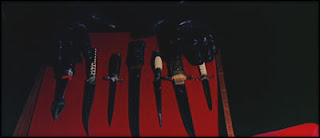
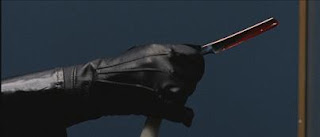
The movie opens with a figure garbed in a black plastic raincoat, black leather gloves and black hat lingering fetishistically over a series of wicked-looking hunting knives in a red velvet-lined case, then stalking and photographic a young woman before killing her. It's a pretty standard opening for a giallo, and most people probably forget it happens because two scenes later there is an astonishing setpiece that sets the tone not just for the movie, but for Dario Argento's entire career.

Sam Dalmas, an American trying to solve his writer's block with a holiday in Rome, sees two figures struggling over a knife in an art gallery - one a woman, the other dressed in black plastic raincoat, black leather gloves and black hat. He rushes to help but becomes trapped between two sets of glass doors, unable to get into the gallery or back out to the street. He watches helplessly as the figure in black flees and the woman, having been stabbed in the stomach, crawls across the floor in agony.

The woman survives, and when the police question Sam he is certain that he's seen a crucial clue but he can't quite remember what it is. When the police take away his passport to retain him as a witness, believing the attack to be only the latest in a series of attacks by a serial killer, he decides that he really needs to solve the murders himself.
Something that tends to strike people who see this movie after a number of Argento's later works is how tightly plotted it is. His later movies - especially from Suspiria onwards - often feature stories that are either impossibly convoluted (e.g. Tenebre) or downright nonsensical (particularly Phenomena). But at this stage of his career Argento regarded himself as a writer rather than as a director, and apparently only insisted on directing this one because he was sick of seeing other directors ruin his scripts. (One hopes he was at least satisfied with Sergio Leone's handling of Once Upon a Time in the West, which he co-wrote with Bernardo Bertolucci).
Given this, while I've always been quite cavalier about throwing around blatant spoilers on this blog, The Bird with the Crystal Plumage is a pretty great murder mystery and if you haven't seen it you really should go out and rent it, then come back here and read the rest of this. It's now easily available on DVD in most territories, so you shouldn't have any trouble finding it.
If you've seen the movie, or don't give a damn if I ruin the ending, then read on. I'll be talking about the identity of the killer before I reach the end of the synopsis, so don't say I didn't warn you. Now let's go on...
The Bird with the Crystal Plumage was one of the most crucial movies in that very particular Italian subgenre known as the giallo. Named for the colour of mystery paperback covers, a giallo started off just as an Italian murder mystery in which a good percentage of the characters are offed by a killer, usually motivated by greed. The great horror director Mario Bava is usually credited with the first giallo movies, The Girl Who Knew Too Much and Blood and Black Lace, and the latter film in particular was a huge influence of Argento's first movie; Blood and Black Lace's killer dresses almost identically to the one in Bird. But neither of Bava's movies was an international hit on the scale that Bird was to become, and so it was the latter movie that really established this as the costume of the giallo villain.

Argento's penchant for playing the gloved hands of the killer also started with this movie. This is one of the elements that earned him the reputation for being a misogynist, but it's more complicated than that. It's true that Argento identifies with his killers, and it's also true that many of the murders in his movies are highly sexualised and that the victims are usually beautiful women. Quotes like this one don't help either:
"I like women, especially beautiful ones. If they have a good face and figure, I would much prefer to watch them being murdered than an ugly woman or a man."

Which compares interestingly with this famous quote from Edgar Allan Poe:
"The death of a beautiful woman is, unquestionably, the most poetical topic in the world."

I would argue that the key part of Argento's quote is right at the start. Any kind of careful viewing of his movies shows that he really loves women. I'll get more into this as we go through his filmography, especially one we get into the movies with female protagonists, but straight away in this one we have the simple example that Argento identifies very strongly with the killer - who turns out to be a woman. In fact, the killer turns out to be the victim from that key scene in the art gallery; the clue that Sam has missed is that the man in the raincoat was not attacking, but was in fact defending himself. The man was the killer's husband, who ends up confessing to the killings in order to protect his wife.
The real identity of the killer is revealed in a surprise ending. Unlike the gratuitous twists that modern filmgoers are used to, this one is actually the most important part of the story, and rewatching the movie knowing the ending is actually a lot of fun. Argento doesn't cheat the viewer; all the clues are there throughout.
One key image in this movie is a painting of a woman being brutally attacked. This painting depicts a long-suppressed trauma in the killer's life, and when she sees it she is tipped over into psychosis. As the movie's postscript (which amusingly, and slightly mockingly, pays homage to Psycho) explains, seeing the painting has somehow shifted her self-identification away from being the victim into being the attacker, compelling her to repeatedly re-enact her own attack from the other side.

There's an odd sequence in this movie where a completely different killer shows up, played by the scary-looking Reggie Nalder. This killer uses a gun, and turns out to be a hitman hired by the main killer to eliminate Sam. I don't recall ever seeing another movie where a serial killer hires a hitman. Dealing with a serial killer turns out to be a bad idea, as Nalder later turns up dead himself.

Although Argento had never directed before, nothing about The Bird with the Crystal Plumage demonstrates any neophyte clumsiness. This might simply be down to the fact that he is surrounded by first-rate craftspeople; the cinematographer is Vittorio Storaro (Apocalypse Now, 1900), the music is by Ennio Morricone (who had already composed over a hundred scores, including all of Sergio Leone's westerns, and would go on to compose over three hundred more), etc. He had also grown up with the movies, as his father was a producer and his mother an actor, and before becoming a scriptwriter he was a film critic.
In any case, I'm sure that we can ascribe the beautiful look of the movie to Vittorio Storaro. Anyone who has only ever seen this movie on VHS really needs to check out the DVD as soon as possible.


Sam Dalmas, an American trying to solve his writer's block with a holiday in Rome, sees two figures struggling over a knife in an art gallery - one a woman, the other dressed in black plastic raincoat, black leather gloves and black hat. He rushes to help but becomes trapped between two sets of glass doors, unable to get into the gallery or back out to the street. He watches helplessly as the figure in black flees and the woman, having been stabbed in the stomach, crawls across the floor in agony.

The woman survives, and when the police question Sam he is certain that he's seen a crucial clue but he can't quite remember what it is. When the police take away his passport to retain him as a witness, believing the attack to be only the latest in a series of attacks by a serial killer, he decides that he really needs to solve the murders himself.
Something that tends to strike people who see this movie after a number of Argento's later works is how tightly plotted it is. His later movies - especially from Suspiria onwards - often feature stories that are either impossibly convoluted (e.g. Tenebre) or downright nonsensical (particularly Phenomena). But at this stage of his career Argento regarded himself as a writer rather than as a director, and apparently only insisted on directing this one because he was sick of seeing other directors ruin his scripts. (One hopes he was at least satisfied with Sergio Leone's handling of Once Upon a Time in the West, which he co-wrote with Bernardo Bertolucci).
Given this, while I've always been quite cavalier about throwing around blatant spoilers on this blog, The Bird with the Crystal Plumage is a pretty great murder mystery and if you haven't seen it you really should go out and rent it, then come back here and read the rest of this. It's now easily available on DVD in most territories, so you shouldn't have any trouble finding it.
If you've seen the movie, or don't give a damn if I ruin the ending, then read on. I'll be talking about the identity of the killer before I reach the end of the synopsis, so don't say I didn't warn you. Now let's go on...
The Bird with the Crystal Plumage was one of the most crucial movies in that very particular Italian subgenre known as the giallo. Named for the colour of mystery paperback covers, a giallo started off just as an Italian murder mystery in which a good percentage of the characters are offed by a killer, usually motivated by greed. The great horror director Mario Bava is usually credited with the first giallo movies, The Girl Who Knew Too Much and Blood and Black Lace, and the latter film in particular was a huge influence of Argento's first movie; Blood and Black Lace's killer dresses almost identically to the one in Bird. But neither of Bava's movies was an international hit on the scale that Bird was to become, and so it was the latter movie that really established this as the costume of the giallo villain.

Argento's penchant for playing the gloved hands of the killer also started with this movie. This is one of the elements that earned him the reputation for being a misogynist, but it's more complicated than that. It's true that Argento identifies with his killers, and it's also true that many of the murders in his movies are highly sexualised and that the victims are usually beautiful women. Quotes like this one don't help either:
"I like women, especially beautiful ones. If they have a good face and figure, I would much prefer to watch them being murdered than an ugly woman or a man."

Which compares interestingly with this famous quote from Edgar Allan Poe:
"The death of a beautiful woman is, unquestionably, the most poetical topic in the world."

I would argue that the key part of Argento's quote is right at the start. Any kind of careful viewing of his movies shows that he really loves women. I'll get more into this as we go through his filmography, especially one we get into the movies with female protagonists, but straight away in this one we have the simple example that Argento identifies very strongly with the killer - who turns out to be a woman. In fact, the killer turns out to be the victim from that key scene in the art gallery; the clue that Sam has missed is that the man in the raincoat was not attacking, but was in fact defending himself. The man was the killer's husband, who ends up confessing to the killings in order to protect his wife.
The real identity of the killer is revealed in a surprise ending. Unlike the gratuitous twists that modern filmgoers are used to, this one is actually the most important part of the story, and rewatching the movie knowing the ending is actually a lot of fun. Argento doesn't cheat the viewer; all the clues are there throughout.
One key image in this movie is a painting of a woman being brutally attacked. This painting depicts a long-suppressed trauma in the killer's life, and when she sees it she is tipped over into psychosis. As the movie's postscript (which amusingly, and slightly mockingly, pays homage to Psycho) explains, seeing the painting has somehow shifted her self-identification away from being the victim into being the attacker, compelling her to repeatedly re-enact her own attack from the other side.

There's an odd sequence in this movie where a completely different killer shows up, played by the scary-looking Reggie Nalder. This killer uses a gun, and turns out to be a hitman hired by the main killer to eliminate Sam. I don't recall ever seeing another movie where a serial killer hires a hitman. Dealing with a serial killer turns out to be a bad idea, as Nalder later turns up dead himself.
Although Argento had never directed before, nothing about The Bird with the Crystal Plumage demonstrates any neophyte clumsiness. This might simply be down to the fact that he is surrounded by first-rate craftspeople; the cinematographer is Vittorio Storaro (Apocalypse Now, 1900), the music is by Ennio Morricone (who had already composed over a hundred scores, including all of Sergio Leone's westerns, and would go on to compose over three hundred more), etc. He had also grown up with the movies, as his father was a producer and his mother an actor, and before becoming a scriptwriter he was a film critic.
In any case, I'm sure that we can ascribe the beautiful look of the movie to Vittorio Storaro. Anyone who has only ever seen this movie on VHS really needs to check out the DVD as soon as possible.


Monday, August 2, 2010
New project: Dario Argento
It's time to start a new project, this time one with a rigorous schedule. I am going to watch and write about every movie directed by Dario Argento, at a rate of one per week, starting tomorrow, and in chronological order. So it's going to be Dario Argento Tuesday.

My first Dario Argento movie was Suspiria, and it changed the way that I look at movies forever. It taught me that a disregard for narrative and character does not need to be a flaw, and that all a movie need to do in order to be compelling is to present visuals and sounds in an intoxicating, thrilling manner. He has written and directed a good number of my absolute favourite movies, though his work in the last twenty years has been depressingly weak. The last few weeks of this project are likely to be quite depressing.
As well as the movies he has directed, I will be examining the movies he co-wrote and produced that were directed by his proteges. I'm also throwing in Dawn of the Dead on the grounds that he completely re-edited the movie for its European release, coming up with a version of the movie very different from the intentions of writer/director George A. Romero (though with Romero's permission and blessings).
Here is my schedule. I'll resist putting dates beside them just yet in case something dreadful happens to delay me, but there should be a new review each Tuesday. I'll put the links in here as the reviews go up.
The Bird with the Crystal Plumage (1970) - 3 August 2010
The Cat o' Nine Tails (1971) - 10 August 2010
Four Flies on Grey Velvet (1971)
Door Into Darkness: The Tram (1973, TV)
Door Into Darkness: Eyewitness (1973, TV)
The Five Days (1973)
Deep Red (1975)
Suspiria (1977)
Inferno (1980)
Tenebre (1982)
Phenomena (1985)
Demons (1985, producer/co-writer only)
Demons 2 (1986, producer/co-writer only)
Opera (1987)
The Church (1989, producer/co-writer only)
Two Evil Eyes: The Black Cat (1990)
The Sect (1991, producer/co-writer only)
Trauma (1993)
The Stendahl Syndrome (1996)
The Wax Mask (1997, producer/co-writer only)
The Phantom of the Opera (1998)
Sleepless (2001)
The Card Player (2004)
Do You Like Hitchcock? (2005)
Masters of Horror: Jenifer (2005, TV)
Masters of Horror: pelts (2006, TV)
The Mother of Tears (2007)
Giallo (2009)
Subscribe to:
Posts (Atom)