Showing posts with label Giallo. Show all posts

Thursday, November 27, 2014

Raising Cain (1992)


"I am what you made me, Dad."

Dr. Jenny O'Keefe seems to have it all. She has a successful career in medicine, a beautiful home, and a caring husband who has taken time off his own career as a psychiatrist to look after their young daughter. But her husband, Carter Nix, has been acting strangely lately. His attitude towards their daughter seems to have shifted from parental love into obsession, almost as if he's studying her, and he's been exhibiting swings in mood and personality. Perhaps that's why she is so quick to jump back into the arms of her former lover Jack Dante when he unexpectedly reappears in her life. And perhaps it's why she's been having these terrible nightmares.


In fact, things are much worse than Jenny imagines. Carter's tyrannical father, long thought dead, has come to town and brought with him Carter's identical twin brother Cain. Carter has found himself ensnared in his father's bizarre baby-kidnapping plans. Of course he's a good man at heart so there are boundaries he won't cross, but Cain has no such moral qualms. When the brothers find out about Jenny's affair with Jack, Cain comes up with a sadistic plan to take care of both of them in one go. And that's when things start to get really weird.

Monday, January 31, 2011

Review: Black Swan (2010)

Whew, now this was a good time at the movies. Black Swan is a lurid psychological thriller in the mold of Roman Polanski's early movies, especially Repulsion, Rosemary's Baby and The Tenant. It's also probably the closest we'll ever get to a Hollywood remake of Satoshi Kon's anime masterpiece Perfect Blue, and it draws further influence from 1970s giallo movies. It's pure cinema.


Natalie Portman stars as Nina, a neurotic ballerina attempting the role of the Swan Queen in a production of Swan Lake. Mila Kunis plays her chief rival Lily, who is either extremely friendly, extremely competitive, or both; Barbara Hershey is her highly strung and overbearing mother Erica; and Vincent Cassel is the tyrannical director/choreographer Thomas. Winona Ryder makes a strong impression in a small role as Nina's predecessor, Beth.

Almost straight away the movie lets us know that something is wrong with Nina: she sees her doppelganger for the first time in the first few minutes of the movie. The whole movie portrays her point of view, which is highly paranoid and filled with hallucinations. There is a strong focus on nacissistic doubling: Nina sees hallucinations of herself and of other people with her face; Kunis parallels and contrasts with her throughout; Beth embodies a possible end result for Portman's character; Erica is reliving her own failed career through her daughter. Everywhere she looks, Nina sees nothing but her own reflection.


Like this!

Nina's relationship with Thomas is fascinating: it's antagonistic in the extreme, as he plays mind games with her and manipulates her sexually while seeming to be uninterested in actually going through with seducing her. It's the exact places where her mind is unravelling that cause him to want her for the role of the Swan Queen. The doubling with Lily is also interesting, as she is portrayed as everything Nina won't let herself be. Mila Kunis is brilliant in the role, which requires her to strike the perfect balance between being sympathetic and antagonistic. Nina is simultaneously drawn to and repelled by Lily, which culminates in an astonishingly steamy scene that I'm sure will draw many people to the theatre on its own.


It's a very body-conscious movie all around. The camera obviously lingers on the dancers' bodies, particularly that of Natalie Portman (and her pronounced clavicles). A lot of attention is paid to the movement of feet, with amplified cracks on the soundtrack to emphasise the unnatural pressure that is being put on them. Skin bruises, ruptures and splits throughout the movie, and if you are at all sensitive about your cuticles you'll definitely have trouble with some scenes (just thinking about this is making it difficult to type). There are also some sequences showing some pretty astonishing muscle movement in a couple of dancers' backs; at least once this is definitely accentuated by CGI, but at other times I was unsure. Although it's rarely especially gory, it's definitely not a movie for the squeamish - many scenes are designed to make the audience squirm.


The music is a star in itself. Composer/arranger Clint Mansell (previously the frontman for the great British band Pop Will Eat Itself) brilliantly arranges passages from Tchaikovsky's Swan Lake in ways that rarely call attention to themselves except when they are supposed to. This score rivals his collaboration with the Kronos Quartet on Requiem for a Dream for sheer power.

Black Swan has too much of the sort of dialogue where characters describe what they think and how they feel, but fortunately all of the actors are strong enough that they also embody the emotions and contradictions within the characters. Perhaps the filmmakers thought that the rubber reality inherent in the movie required some things to be spelled out verbally to allow the audience to "get it," but I did find it a little irritating. Still, decent dialogue is in sparse supply even in good movies so I'm not going to complain too much about it.


It's also not a particularly original movie, though I'm sure it's going to be acclaimed as such by people who haven't seen the movies it's been influenced by. I'm not going to go into that here; there's already plenty of information on this available elsewhere. But at the end of the day, how many truly original movies are there? At least there is actual substance to this movie, unlike the recent and vastly overrated Inception, whose brilliant action sequences were the only compensation for a script that stole only the most superficial elements of Satoshi Kon's mind-bending anime feature Paprika.

I thoroughly enjoyed Black Swan. Technically it's very accomplished, the acting ranged from solid to masterful, there's plenty to chew on, and it packs a powerful visceral punch. See it even if just for Mila Kunis, whose star is definitely on the rise.

Tuesday, August 17, 2010

Four Flies on Grey Velvet (1972)

Roberto Tobias, a drummer in a rock band, has been noticing a man following him for about a week. When he sees the man late at night after a band practice, he follows and then confronts him in an abandoned theatre. The man pulls a switchblade, and in the struggle he is stabbed and seems to die. As Roberto stands over the body with the bloodied knife in his hand, a spotlight is turned on him from the gallery where a masked figure starts taking photographs of him. He flees, but soon he starts receiving packages from the mysterious witness - the dead man's wallet, photographs of the murder, and worse. He confesses everything to his wife Nina, who urges him to run away with her, but he refuses as he's scared that he'll end up in prison for murder. Then their maid discovers what's going on and tries blackmail; when she turns up dead it's clear that Roberto and Nina are caught in a trap that neither will be able to escape unscathed.


On the advice of his friend God (played by slapstick comedian Bud Spencer) Roberto hires Gianni Arrosio, a flamboyantly gay private investigator who swiftly manages to uncover the identity of the blackmailer. Poor Gianni should have realised that if you want to survive a murder mystery, you need to do that right at the end of the story...

This is a fascinating movie. In some ways it seems slapdash and inconsistent, and there are some dreadful comic relief bits that really don't work, but even these scenes are closely linked to the movie's thematic concerns. It has an elaborate visual style that at first seems gratuitous but which turns out to be centered around revealing the themes of the movie. The murder mystery itself is extremely difficult to work out, cheats several times and requires the killer to pretty much be a mind-reader, but its resolution really clarifies everything that the movie is doing.


It's very much the transitional movie between his first movies, which were stylish but very tightly written and plot-driven, into his later movies, which were much more personal and often abandoned conventional plotting in favour of his visual and thematic obsessions. This is blatantly signalled in the scene where Roberto enters the theatre at the start - the camera passes through several layers of deep red curtains, in anticipation of what was to be his breakthrough movie three years later...

In short, this is the movie which reveals that Dario Argento's main influence is less Alfred Hitchcock, as is commonly presumed, and more Michaelangelo Antonioni. It even references (and parodies) the ending of Zabriskie Point. This connection to Antonioni would become even more clear when he made Deep Red.... but we'll get to that in a few weeks.

Four Flies on Grey Velvet is a movie about gender, sexuality and repression; as with every Argento movie it's also about perception, and how what you see is not necessarily the truth. I'm going to give away a few salient points now (including the identity of the killer and what really happened in the opening scene) so if you haven't seen the movie and want to watch it without foreknowledge, now is the time to stop reading.

Watching Four Flies a second time was more interesting because knowing that the opening scene was a setup and that the "murder" was fakes with a trick knife and a blood bag, and that the killer is actually Nina, makes everything play very differently. As the final scene reveals, Nina was raised as a boy by an unhinged father, and is played by the androgynous American actress Mimsy Famer, who is spectacular in the role. This makes the scene where she kills Gianni in an unisex toilet very interesting; usually a scene of a gay man being killed in a toilet would seem homophobic, but not this time.


Gianni is actually the smartest and most sympathetic character in the whole movie, and although his mannerisms are rather stereotyped he is a vast improvement over the gay stereotypes in most movies of the period. Four Flies actually puts Argento at three for three in featuring sympathetic gay characters in his movies, after the art dealer in The Bird with the Crystal Plumage and the rude yet likable Dr. Braun in The Cat o' Nine Tails, and according to Argento's biographer Alan Jones he wanted to make a movie with only gay characters but the idea was vetoed by his producers.

Comic relief scenes involving a mailman delivering pornography to the wrong address are cringingly unfunny, but serve to highlight the sexuality/repression theme - especially as the person who receives them in error is a sexually repressed woman who is later revealed to be secretly in love with Roberto.

Speaking of Roberto, he is a very unlikable and even obnoxious character. After seemingly commiting murder, his only reaction is fear of being caught. He treats Nina very badly (which, as it turns out, plays directly into her obsessions) and thoughtlessly cheats on her with her young cousin. He lashes out at the mailman, mistaking him for the blackmailer and gives him a sound thrashing before realising his mistake.

Like Nina, Roberto is an androgynous figure, and despite the homophobia he displays upon first meeting Gianni (in a scene that playfully challenges the audience's own homophobia) many of his interactions with other male characters have a homoerotic subtext to him. It's interesting that, as played by David Brandon, he closely resembles Argento himself.

Nina's motivation for tormenting Roberto turns out to be very twisted indeed. She seduced and married him specifically because he bears a very close physical resemblence to her dead father. He had died while she was committed to a psychiatric institution, so she was looking for someone to torment and murder in his place. In the end, as she is about to kill him, he is saved by divine intervention as God actually bursts into the room and chases her off!


God himself is an interesting character. He's sourced from the novel The Screaming Mimi by Frederic Brown, which was the uncredited source material that The Bird with the Crystal Plumage had, er, borrowed from. He's a big burly man with a black beard who lives in a shack by the river and lives off raw fish. He's actually introduced with a chorus of "Hallelujah," in an example of the movie's ham-fisted sense of humour. Like many homeless people in movies, God is deeply philosophical. He has a sidekick called The Professor, who constantly quotes from the Bible. I must confess that I'm unsure of the exact significance of these irreverently religious figures.

Four Flies on Grey Velvet stretches this kind of giallo about as far as it can go. It's pretty clear that Argento was unlikely to want to continue in this vein, and with his next movie he moved out of the thriller genre entirely for the only time in his career to date, with the spectacularly unsuccessful The Five Days. However first he was engaged to produce and host a series of four thrillers for the Italian television netowkr RAI, called The Door Into Darkness, and ended up writing and directing two of these himself. In the manner of Alfred Hitchcock Presents, these were to make Argento into a genuine star in his own country, and we'll look at the first of these next week - The Tram, which was actually based on an episode he cut out of the script of his first movie.

Tuesday, August 10, 2010

The Cat o' Nine Tails (1971)

A middle-aged blind man and a young girl overhear a snatch of a conversation involving blackmail. Soon they discover that it involves a break-in at a prestigious medical institution. They start investigating, with the help of a journalist, and soon the bodies are piling up.

The Cat o' Nine Tails is a fairly standard murder mystery, co-written and directed by Dario Argento, who seems determined to set it apart from his previous movie, The Bird with the Crystal Plumage. Unfortunately what he has mostly done is to remove all of the most interesting and distinctive elements. Without Argento's trademark obsessions, and with a far less distinctive mise-en-scène, what's left is mostly a fun but forgettable giallo. There are plenty of twists and turns and an amazing amount of red herrings, but nothing that really gets its fish-hooks into you.

There are still some points of interest, both conceptually and visually, and they mostly have to do with the theme of perception that runs through many of Argento's movies. This one is very concerned with the eye. Arno is blind, and when not wearing dark glasses Karl Malden is very good at suggesting this with a far-away stare. The presence of the killer is always signaled by huge closeups of his retina. A key clue is provided by a photograph which is incomplete; the full version contains a clue at the very edge of the frame - at the edge of perception.

Eye of a killer

Some bizarre editing also adds to the fun. Most intriguing is the scene towards the start where the break-in occurs. We are watching Arno assemble a crossword puzzle (he has an interesting braille device for doing so) when suddenly we start getting quick cuts of the break-in in progress. Arno looks alarmed and goes to check on Lori (the young girl under his care - we never find out the precise nature of their relationship) before opening the window and "looking" out. His apartment overlooks the Institute - but of course he cannot see anything. The killer, having just dispatched the night watchman, looks up just in time to see Arno's shutters closing again.

This sequence strongly implies a psychic vision, as if Arno's lack of sight has opened up other avenues of perception, but it is never referred to again. But it's an interesting first glimps; psychic powers would become important in some of Argento's later movies.

That relationship between Lori and Arno (who she called Cookie "because he's sweet") is vaguely troubling. Arno says that he has no relatives and she has no parents so they need each other. Is he her uncle, the brother of one of her dead parents? He's been blind for 15 years and she is well under 15 eyars old; who decided that a blind bachelor would be the best person to raise a young girl? There's a lot of physical affection between them, most of it from him; it could all be seen as innocent, but later in the movie we find out that two other characters who are father & daughter by adoption are in a sexual relationship.

Arno and Lori - dodgy or not?

It grows even more troubling when you look at Dario Argento's strange screen relationship with his oldest daughter Asia (who was not yet born when Cat o' Nine Tails was made), and it certainly adds something disturbing to the movie.

There are red herrings galore, and almost every character is a suspect at one point or another. The chief suspect, almost from the beginning, is Dr. Braun, a German scientist who is blunt, rude and (it is eventually revealed) homosexual. Gay characters tended to be villains in movies like this, and when the idea of the killer having a chromosonal imbalance (the dreaded XYY, which had already been dragged out in movies like Twisted Nerve) is revealed the audience is lead to believe that Braun is the most likely culprit. However the movie presents its gay characters with more respect than is normal in a movie of its vintage, as was the case with the gay art dealer in The Bird with the Crystal Plumage. They are still clichés, but at least they are sympathetic clichés.

The cinematography is by Erico Menczer, who is a craftsperson where Bird cinemotographer Vittorio Storaro is an artist. There are still some cool shots of staircases, and the camera prowls restlessly in some scenes, but the startling compositions of the earlier movie are missed.

Fortunately the soundtrack by Ennio Morricone is top-notch. Working with orchestrator Bruno Nicolai, as he usually did when scoring a giallo, Morricone provides a score driven by an ominous pulsing bassline that helps to propel the movie forward. A good amount of the movie's atmosphere is provided by this score.

The acting is good throughout. Karl Malden is great fun as Arno, and James Franciscus is solid as reporter Giordani. Eurohorror mainstay Rada Rassimov has a good role the fianceé of one of the victims, though Catherine Spaak's role as the daughter of the Institute's head is under-written, though she does get to drive like an absolute maniac in one terrific scene. Best of all is Horst Frank, clearly relishing his role as Dr. Braun. Spaak and Horst also have amazing early '70s hair.

Love your hair!

One big downside to the movie, though, is that the main characters are basically nosy bystanders. In almost every other Dario Argento movie, the protagonist is inexorably drawn to the murders so that it becomes an obsession. In this case we have a reporter trying to get a story and a guy who "likes puzzles". The personal involvement is deeply missed.

The other main downside, other than the lack of visual splendour, is that the murder setpieces are not very interesting. Apart from one great scene involving murder by train (which has a great cynical topper when the reporters abandon photographing the gruesome body to concentrate on a starlet who has arrived on the same train) they are mostly a series of unconvincing garrottings. Some murders even happen off-screen. Given that the murder scenes are where Argento's movies usually excel, this is very disappointing.

The only good death scene

The movie is also quite frigid, possibly because Argento usually does express sex through violence in his movies. There is one sex scene, and it's startlingly cold and unerotic. This might be partially because there's no obvious chemistry between James Franciscus and Catherine Spaak, but it's also filmed in a startlingly cold manner. I suspect that Argento simply had no idea how to film a normal sex scene.

No chemistry

I have to say, though, that the ending is wonderful. It takes place on a rooftop, with both of our heroes individually confronting the killer. I won't give it away except to say that it refuses to play it safe, with at least two characters left with an ambiguous fate. There seems to be an implication that with all the different cans of worms that Arno and Giordani have opened, even the apprehension of the killer won't contain the chaos that has been unleashed.

If you compare Cat o' Nine Tails to a giallo from, say, Umberto Lenzi or Sergio Martino, it looks pretty good. If you compare it to the movie Argento had just made, and to the other gialli he made in the 1970s, it looks pretty weak. It's all a matter of perception.

Click for a bigger version - I dare you

Wednesday, August 4, 2010

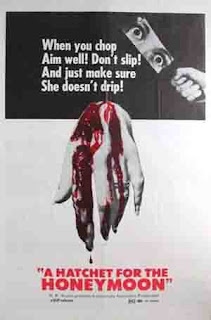
Hatchet for the Honeymoon (1970)

We open on a train, as a man with a meat cleaver stalks a young couple. This opening scene is shot from the point-of-view of the killer, a technique later popularized by Halloween, but despite the subject matter and pulp title the movie quickly develops a poetic, melancholic mood. The first hint of this comes with the evocative shots of a young boy, who we soon realise is the killer's younger self watching him from inside his head. The cinematography uses psychedelic techniques, but rather than this being just a sign of its being made in 1970, it is used to depict the inner life of the killer.

The movie cuts quickly from the opening murder to a close-up of a toy train rattling along a track. Just as we are prepared to mock the movie for such obvious fakery, a hand reaches down and stops the train. The hand belongs to the killer from the opening sequence, and he commences with a voice-over.

"My name is John Harrington. I am a paranoiac. Hmm, paranoiac. An enchanting word, so full of possibilities. The fact is that I am completely mad. The fact remains that I have killed five young women."

Young, vain and impotent - no wonder Stephen Forsyth retired from acting after this role

This is the world of Mario Bava, the co-writer/cinematographer/camera operator/director whose movies embodied all the best elements of the Italian horror movie. Bava's movies, despite their pulp titles and plots and their commercial bent, were almost all intensely personal and distinctive. Hatchet for the Honeymoon is a good example of Bava's art, weaving a sophisticated and multi-layered story out of what would usually be handled as trash. The story is not the point here - it's all in how he handles it. This is pulp poetry of the highest order, and it would be much imitated in the subsequent decade, particularly in the movies of Dario Argento.

John Harrington is portrayed as a vain and shallow young man. At first he seems to be trapped in an unhappy marriage, with a shrewish older wife who refuses to give him a divorce. This rang alarm bells with me, with its misogynistic overtones, but Bava and his cast undermine these elements beautifully. We are given glimpses throughout that Mildred Harrington has been driven to this state by John's manipulative nature and inability to satisfy her.

John is driven by two of the great clichés of movie psychos: issues with his mother, and impotence. What makes this interesting is that, although this is obvious to the audience almost from the start, John himself is unaware of it and is in fact attempting to discover the roots of his own madness. Each time he kills John's memory opens up a little more, and he feels driven to keep killing until he has finally remembered what started him in the first place.

Hatchet for the Honeymoon is in essence a character study. Only one brief scene takes us away from John, so that just once we are left to wonder whether he has committed a murder or not. He is depicted from the beginning as vain and shallow, spending endless time on his appearance. He runs a fashion business specialising in bridal wear left to him by his mother, but Mildred's money bailed it out and it's only her that keeps it afloat (one of several instances where his wife is shown to be a mother substitute). All but one of his victims are all brides-to-be, so that he is always symbolically killing both his wife and his mother.

Then two things happen with unforeseen consequences. John meets a young woman called Helen Wood, and discovers he has actual feelings for her; and he finally kills his wife.

The scene where John kills Mildred is also the one where she is transformed into a sympathetic character. What leads him to kill her is not her mean-spirited comments, as she had displayed earlier in the movie, but her softening towards him. We discover that she really loves John and wants nothing more than for him to love her in return. The coldness in their relationship comes completely from him - they have never actually consummated their marriage because he is impotent. So John dresses as a bride himself, hacks her to death with a meat cleaver, and buries her in the hothouse.

However Mildred is not going to give up on him that easily. Wherever John goes from then on, people keep greeting his wife, asking her opinion, serving her drinks, and even having long conversations with her. They can see her. The camera can see her. But John cannot see her.

The true hero of this movie

This is approach to a ghost story that I don't think I have ever seen before, and it's impressively handled. The movie puts us completely on Mildred's side, while allowing us to feel John's palpable fear at her presence - especially in the few instances when she allows him to see her, and one where she touches him. Bava's tricky camerawork allows her to appear and disappear without cutting, and Laura Betti's excellent performance as Mildred makes these scenes extremely memorable.

After she appears to him and tells him that she will never leave his side, John attempts to exorcise Mildred by digging up her body and cremating her in the furnace. He carries her ashes around with him in a satchel, as a sick joke, but instead of the satchel people continue to see Mildred. It doesn't matter if he throws away the satchel and scatters the ashes - it keeps returning to him.

Meanwhile Helen is pushing John for a sexual relationship, and as for him sex means murder he is unwilling to commit to someone he actually cares for. At the same time a police inspector keeps dropping around to talk to him, obviously thinking that John is the prime suspect (several of the victims were models working for him) and trying to work on his mind in the absence of any physical evidence. The scene where the inspector almost catches John killing Mildred milks it for suspense in a manner that rivals the best of Hitchcock.

The final revelation is not a surprise to the audience, and the final scene - where Mildred gets the last laugh - is also predictable but still extremely satisfying.

This is an excellent thriller, provided you don't mind the end being so predictable. Bava's visual tricks are all tied into exploring character - the uses of many mirrors and reflecting surfaces, for example, or his characteristic use of the zoom to highlight irony. It would not be a bad introduction to Italian horror in general.

Poster

Tuesday, August 3, 2010

The Bird with the Crystal Plumage (1970)

The movie opens with a figure garbed in a black plastic raincoat, black leather gloves and black hat lingering fetishistically over a series of wicked-looking hunting knives in a red velvet-lined case, then stalking and photographic a young woman before killing her. It's a pretty standard opening for a giallo, and most people probably forget it happens because two scenes later there is an astonishing setpiece that sets the tone not just for the movie, but for Dario Argento's entire career.
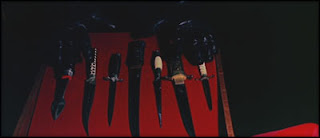
One alternate title for this movie was 'The Sadist with Black Gloves'

Sam Dalmas, an American trying to solve his writer's block with a holiday in Rome, sees two figures struggling over a knife in an art gallery - one a woman, the other dressed in black plastic raincoat, black leather gloves and black hat. He rushes to help but becomes trapped between two sets of glass doors, unable to get into the gallery or back out to the street. He watches helplessly as the figure in black flees and the woman, having been stabbed in the stomach, crawls across the floor in agony.

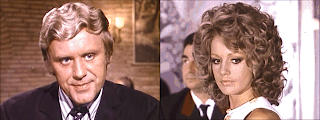
Eva Renzi

The woman survives, and when the police question Sam he is certain that he's seen a crucial clue but he can't quite remember what it is. When the police take away his passport to retain him as a witness, believing the attack to be only the latest in a series of attacks by a serial killer, he decides that he really needs to solve the murders himself.

Something that tends to strike people who see this movie after a number of Argento's later works is how tightly plotted it is. His later movies - especially from Suspiria onwards - often feature stories that are either impossibly convoluted (e.g. Tenebre) or downright nonsensical (particularly Phenomena). But at this stage of his career Argento regarded himself as a writer rather than as a director, and apparently only insisted on directing this one because he was sick of seeing other directors ruin his scripts. (One hopes he was at least satisfied with Sergio Leone's handling of Once Upon a Time in the West, which he co-wrote with Bernardo Bertolucci).

Given this, while I've always been quite cavalier about throwing around blatant spoilers on this blog, The Bird with the Crystal Plumage is a pretty great murder mystery and if you haven't seen it you really should go out and rent it, then come back here and read the rest of this. It's now easily available on DVD in most territories, so you shouldn't have any trouble finding it.

If you've seen the movie, or don't give a damn if I ruin the ending, then read on. I'll be talking about the identity of the killer before I reach the end of the synopsis, so don't say I didn't warn you. Now let's go on...

The Bird with the Crystal Plumage was one of the most crucial movies in that very particular Italian subgenre known as the giallo. Named for the colour of mystery paperback covers, a giallo started off just as an Italian murder mystery in which a good percentage of the characters are offed by a killer, usually motivated by greed. The great horror director Mario Bava is usually credited with the first giallo movies, The Girl Who Knew Too Much and Blood and Black Lace, and the latter film in particular was a huge influence of Argento's first movie; Blood and Black Lace's killer dresses almost identically to the one in Bird. But neither of Bava's movies was an international hit on the scale that Bird was to become, and so it was the latter movie that really established this as the costume of the giallo villain.
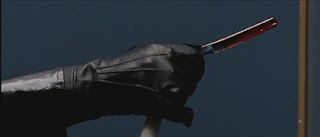
Hands of a director

Argento's penchant for playing the gloved hands of the killer also started with this movie. This is one of the elements that earned him the reputation for being a misogynist, but it's more complicated than that. It's true that Argento identifies with his killers, and it's also true that many of the murders in his movies are highly sexualised and that the victims are usually beautiful women. Quotes like this one don't help either:

"I like women, especially beautiful ones. If they have a good face and figure, I would much prefer to watch them being murdered than an ugly woman or a man."

Poetry?

Which compares interestingly with this famous quote from Edgar Allan Poe:

"The death of a beautiful woman is, unquestionably, the most poetical topic in the world."

This particular woman, the lovely Suzy Kendall is not killed. She is also not mentioned elsewhere in this review. It's a shame.

I would argue that the key part of Argento's quote is right at the start. Any kind of careful viewing of his movies shows that he really loves women. I'll get more into this as we go through his filmography, especially one we get into the movies with female protagonists, but straight away in this one we have the simple example that Argento identifies very strongly with the killer - who turns out to be a woman. In fact, the killer turns out to be the victim from that key scene in the art gallery; the clue that Sam has missed is that the man in the raincoat was not attacking, but was in fact defending himself. The man was the killer's husband, who ends up confessing to the killings in order to protect his wife.

The real identity of the killer is revealed in a surprise ending. Unlike the gratuitous twists that modern filmgoers are used to, this one is actually the most important part of the story, and rewatching the movie knowing the ending is actually a lot of fun. Argento doesn't cheat the viewer; all the clues are there throughout.

One key image in this movie is a painting of a woman being brutally attacked. This painting depicts a long-suppressed trauma in the killer's life, and when she sees it she is tipped over into psychosis. As the movie's postscript (which amusingly, and slightly mockingly, pays homage to Psycho) explains, seeing the painting has somehow shifted her self-identification away from being the victim into being the attacker, compelling her to repeatedly re-enact her own attack from the other side.

I don't know about you, but this picture gives me the creeps

There's an odd sequence in this movie where a completely different killer shows up, played by the scary-looking Reggie Nalder. This killer uses a gun, and turns out to be a hitman hired by the main killer to eliminate Sam. I don't recall ever seeing another movie where a serial killer hires a hitman. Dealing with a serial killer turns out to be a bad idea, as Nalder later turns up dead himself.

Reggie Nalder was rarely described as handsome

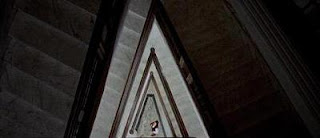
Although Argento had never directed before, nothing about The Bird with the Crystal Plumage demonstrates any neophyte clumsiness. This might simply be down to the fact that he is surrounded by first-rate craftspeople; the cinematographer is Vittorio Storaro (Apocalypse Now, 1900), the music is by Ennio Morricone (who had already composed over a hundred scores, including all of Sergio Leone's westerns, and would go on to compose over three hundred more), etc. He had also grown up with the movies, as his father was a producer and his mother an actor, and before becoming a scriptwriter he was a film critic.

In any case, I'm sure that we can ascribe the beautiful look of the movie to Vittorio Storaro. Anyone who has only ever seen this movie on VHS really needs to check out the DVD as soon as possible.
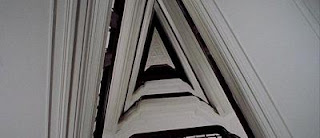
Looking up...

...and looking down


A poster

Monday, August 2, 2010

New project: Dario Argento

It's time to start a new project, this time one with a rigorous schedule. I am going to watch and write about every movie directed by Dario Argento, at a rate of one per week, starting tomorrow, and in chronological order. So it's going to be Dario Argento Tuesday.


My first Dario Argento movie was Suspiria, and it changed the way that I look at movies forever. It taught me that a disregard for narrative and character does not need to be a flaw, and that all a movie need to do in order to be compelling is to present visuals and sounds in an intoxicating, thrilling manner. He has written and directed a good number of my absolute favourite movies, though his work in the last twenty years has been depressingly weak. The last few weeks of this project are likely to be quite depressing.

As well as the movies he has directed, I will be examining the movies he co-wrote and produced that were directed by his proteges. I'm also throwing in Dawn of the Dead on the grounds that he completely re-edited the movie for its European release, coming up with a version of the movie very different from the intentions of writer/director George A. Romero (though with Romero's permission and blessings).

Here is my schedule. I'll resist putting dates beside them just yet in case something dreadful happens to delay me, but there should be a new review each Tuesday. I'll put the links in here as the reviews go up.

The Bird with the Crystal Plumage (1970) - 3 August 2010

The Cat o' Nine Tails (1971) - 10 August 2010

Four Flies on Grey Velvet (1971)

Door Into Darkness: The Tram (1973, TV)

Door Into Darkness: Eyewitness (1973, TV)

The Five Days (1973)

Deep Red (1975)

Suspiria (1977)

Inferno (1980)

Tenebre (1982)

Phenomena (1985)

Demons (1985, producer/co-writer only)

Demons 2 (1986, producer/co-writer only)

Opera (1987)

The Church (1989, producer/co-writer only)

Two Evil Eyes: The Black Cat (1990)

The Sect (1991, producer/co-writer only)

Trauma (1993)

The Stendahl Syndrome (1996)

The Wax Mask (1997, producer/co-writer only)

The Phantom of the Opera (1998)

Sleepless (2001)

The Card Player (2004)

Do You Like Hitchcock? (2005)

Masters of Horror: Jenifer (2005, TV)

Masters of Horror: pelts (2006, TV)

The Mother of Tears (2007)

Giallo (2009)

Thursday, July 29, 2010

Amer (2009)

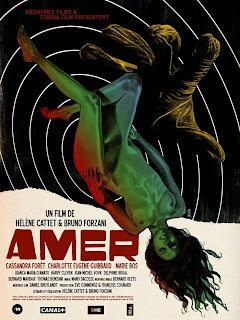
The best thing about this movie is its poster.

Pretty good, right?

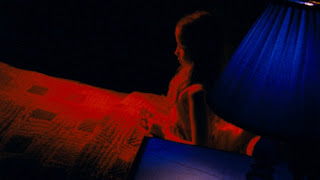
Amer uses the iconography of the giallo in service of a non-narrative art movie. It is extremely technically adept. The first third of the movie is a near-perfect synthesis of visual & aural ideas from Dario Argento's Suspiria and the "Drop of Water" sequence from Mario Bava's I Tre volti della paura. This segment follows a young girl as she attempts to steal her dead grandfather's pocket watch, while hiding in fear from her grandmother (who is portrayed very much as Helena Marcos from Suspiria). There is palpable tension throughout, with a series of vividly creepy images fractured through interesting editing.

Very clearly influenced by Suspiria

Unfortunately I was far less entranced with the second third of the movie, depicting the same girl as a teenager. This third was closer to Stan Brakhage in its extreme visual deconstruction, but without his intellectual rigour. The whole movie seems built around linking sex and death, a theme that's taken from many gialli but which is not developed in an interesting way here: a girl sees her parents making love while she is already in a state of fear and for the rest of her life equates sex with violence.

Something about this girl reminds me of a Svankmajer heroine

The final third of the movie depicts the same character as an adult, and returns to the more threatening tone of the first part of the movie. This is the part where the sexualisation of violence reaches its apex, and my interest was once again piqued. The movie comes full circle at this point: where the first segment features sex depicted as violence and death, the end features violence and death depicted as sex.

More Argento influence

It's just a shame that it was all so empty. If there was more to hang the movie on, or perhaps if the movie was half its present length, the impressive visual and aural techniques (the soundtrack inventively reuses giallo themes by Ennio Morricone, Bruno Nicolai and Stelvio Cipriani) wouldn't seem so much like a formalised experiment. The juxtaposition of sex and death is such a constant in the giallo (and in film in general) that just serving it up once again isn't enough on its own.

This probably sounds like a complete pan, but I actually quite enjoyed Amer. It absolutely nails the aesthetics of a good giallo, and it's a genre I have a lot of affinity for. I have absolutely no problem with style over substance, and I'm a fan of non-narrative film. I loved the homages to many individual movies throughout Amer - not just gialli but also things ranging from Un Chien Andalou to Jan Svankmajer's Down to the Cellar.

Amer is a feast for the senses, deeply sensual and arousing. I guess I'm a little confused by it - I'm tempted to go again to the Sunday session.

Sex and death are very interesting, don't you think?

Monday, July 12, 2010

Seven Deaths in the Cat's Eye (1973)

When it comes to late-night escapism, I have a particular love of Italian movies involving beautiful women solving mysteries in crumbling castles while the bodies pile up around them. Antonio Margheriti's 1973 giallo Seven Deaths in the Cat's Eye has all of the ingredients I'm looking for and more. The presence of Jane Birkin in the lead role certainly helps, but I think it was the gratuitous gorilla that really sold me on this one.

Peek-a-boo

Corringa (Jane Birkin) has just arrived at Dragonstone, her family's castle in Scotland, to find that all is not well. Her aunt Lady Mary MacGrieff (Françoise Christophe) has been unsuccessfuly trying to get a loan from Corringa's mother Lady Alicia (Dana Ghia) so she can afford to hold on to the castle, for the good of the family name of course. Lady Mary's son James (Hiram Keller) spends all of his time insulting the guests, wandering through secret passages, and looking after his pet gorilla. Dr. Franz (Anton Diffring) explains that James has not been right in the head since he murdered his baby sister when they were children.

Meanwhile, nobody seems to know about the rat-eaten corpse in the cellar except for a very fat ginger cat that also conveniently manages to be present every time one of the guests is murdered...

Peek-a-boo

Seven Deaths in the Cat's Eye is a hybrid of several subgenres, mostly giallo and gothic horror, with elements of the German krimi movies thrown in. Early on there are whispers of a vampiric curse, where if one family member murders another they will rise from the grave as a vampire to seek revenge, but this mostly just prompts a vivid dream sequence where Corringa dreams that her mother is urging her to avenge her death. All other hints of the supernatural turn out to be red herrings, as does the gorilla.

Vampire dreams

Jane Birkin's then-husband and frequent collaborator Serge Gainsbourg turns up as a police inspector with a talent for turning up at the most inconvenient times. Thanks to the miracles of dubbing, we get the bizarre spectacle of France's greatest popular musician speaking in a broad Scottish brogue. Gainsbourg's unnamed inspector is unusually sharp for a cop in an Italian horror movie; not only does he put together the solution to the case before anyone else, he deservedly gets the last word in the movie, and manages to save a couple of lives to boot.

Jane Birkin and Serge Gainsbourg

Not too many lives though. This is a giallo first and foremost, and it wouldn't work out too well if there weren't a string of colourful murders. Even the poor gorilla gets it in the neck.

I thoroughly enjoyed Seven Deaths in the Cat's Eye, though I have to admit it was a pretty terrible movie in most respects. It is reasonably nicely shot, filled with fairly reliable European character actors (Luciano Pigozzi, the Italian equivalent to Peter Lorre, shows up just long enough to get his throat cut), and it has no shortage of silly goings on.

Typical Italian horror movie coloured lighting

If you're a fan of this sort of thing already, there are far worse movies you can watch. If you're a newcomer to Italian horror movies, this is not the place to start.


The lovely Jane Birkin and friend